STON.fi Tokenomics: Why STON Failed to Capture the DEX's Growth
STON.fi is the number one DEX on TON by TVL, yet STON trades 98.7% below its April 2024 peak. The gap is value capture, not utility: of $5.63M in annual fees, $1.47M (26%) reached the protocol — and no trader needs the token. A data-led breakdown with the 8Blocks rating of 63/100 (BBB).
STON.fi is the largest decentralized exchange on TON by total value locked ($25.6M, DefiLlama, 20 August 2026), yet its native token STON trades 98% below its April 2024 all-time high. The gap is not utility — it is value capture. Only about 26% of STON.fi trading fees reach the protocol, and no trader needs STON to use the DEX.
8Blocks rated STON 63/100 (BBB) in its May 2026 tokenomics audit. The score is held back by one block: Token-Product Linkage, worth 40% of the framework, scored 2.9 out of 5.
STON at a glance (20 August 2026)
| Metric | Value | Source |
|---|---|---|
| Price | $0.44 | CoinGecko |
| Market cap / FDV | $30.9M / $43.9M | CoinGecko |
| Circulating supply | 70.5M of 100M capped | CoinGecko |
| Drawdown from ATH ($32.65, 12 Apr 2024) | −98.7% | 8Blocks audit, CoinGecko |
| STON.fi TVL | $25.6M (peak $373M, Jul 2024) | DefiLlama |
| Trading fees, last 12 months | $5.63M | DefiLlama |
| Of which reaches the protocol | $1.47M (26%) | DefiLlama |
| 8Blocks rating | 63/100 (BBB) | 8Blocks audit, May 2026 |
Cover: STON.fi's engine runs; the token stands beside it.
What STON.fi actually is, and how big the protocol is today
STON.fi is an automated market maker (AMM) and decentralized exchange built on TON (The Open Network), and STON is its native utility and governance token. The two are frequently conflated: STON.fi is the business, STON is the claim on that business — and the whole argument of this article is that the claim is weaker than the business.
By total value locked, STON.fi is the number one DEX on TON: $25.6M against $4.6M for DeDust and $3.6M for TONCO (DefiLlama, 20 August 2026). It runs AMM pools, liquidity farming, staking, DAO governance, and Omniston, an in-house routing aggregator that sources liquidity across venues to improve execution.
That said, "leading DEX on TON" is a statement about market share, not about growth. STON.fi TVL peaked at $373M in July 2024 and now sits at $25.6M — a 93% contraction. Monthly DEX volume over the last year has ranged between $65M and $331M (DefiLlama). STON.fi kept the crown while the whole TON DeFi market shrank around it.
Is STON.fi a real business or a token wrapper?
STON.fi is a real business. Over the last 12 months, users paid $5.63M in trading fees on STON.fi (DefiLlama, TTM to 20 August 2026). That places it far above the majority of DeFi tokens, where the protocol would keep running unchanged if the token disappeared tomorrow. The problem starts one step later: with how little of that $5.63M can ever reach a STON holder.
How much of STON.fi's fee flow actually reaches STON
Only about 26% of STON.fi's trading fees are available to the token. STON.fi charges a 0.3% base fee on constant-product pools, split 0.2% to liquidity providers and 0.1% to the protocol (8Blocks audit, §4.2). DefiLlama's split confirms the design in practice: of $5.63M in fees over the last 12 months, $4.16M (74%) went to liquidity providers and $1.47M (26%) became protocol revenue. Only that $1.47M enters the Fee Converter, is swapped into STON, and is then distributed by DAO vote between burning, staking rewards, grants, and liquidity mining.
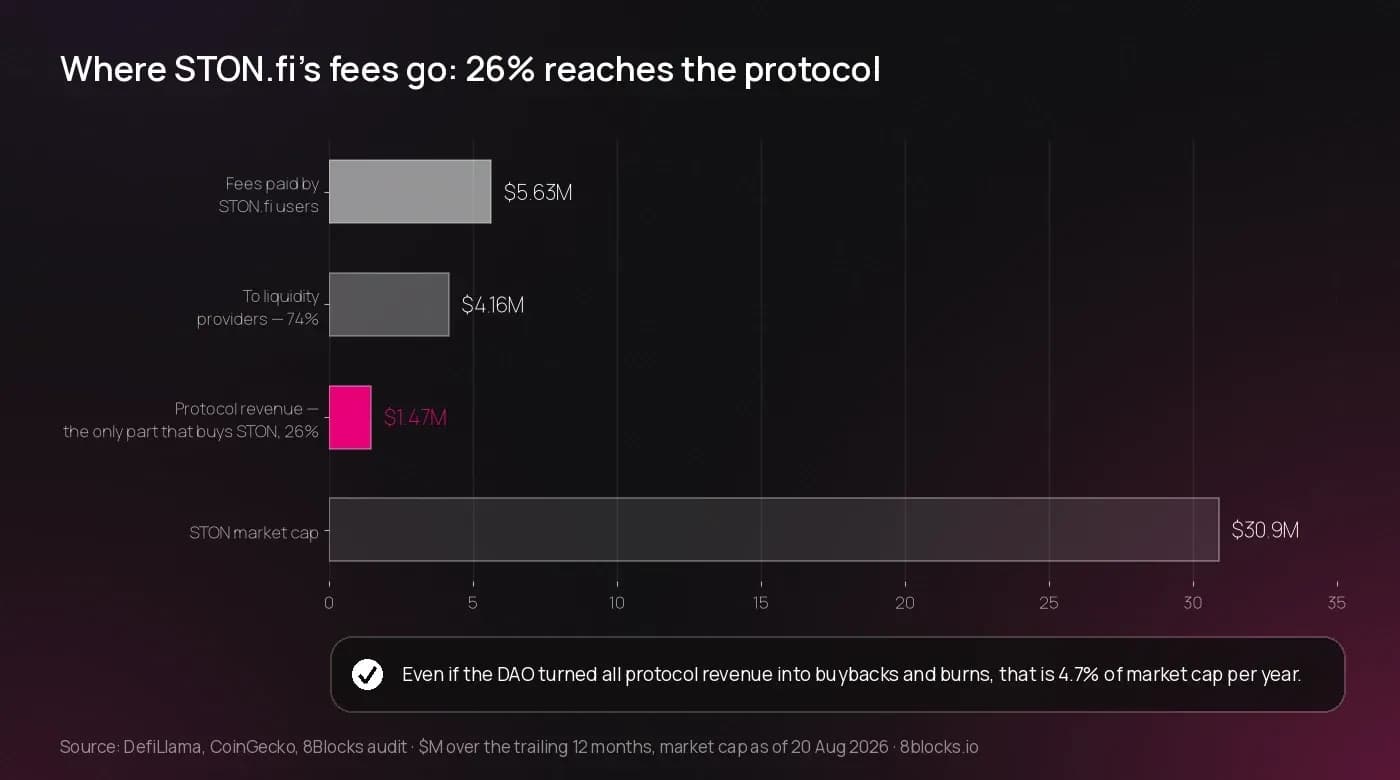
Where STON.fi's fees go: 26% reaches the protocol. Source: DefiLlama, 20 Aug 2026.
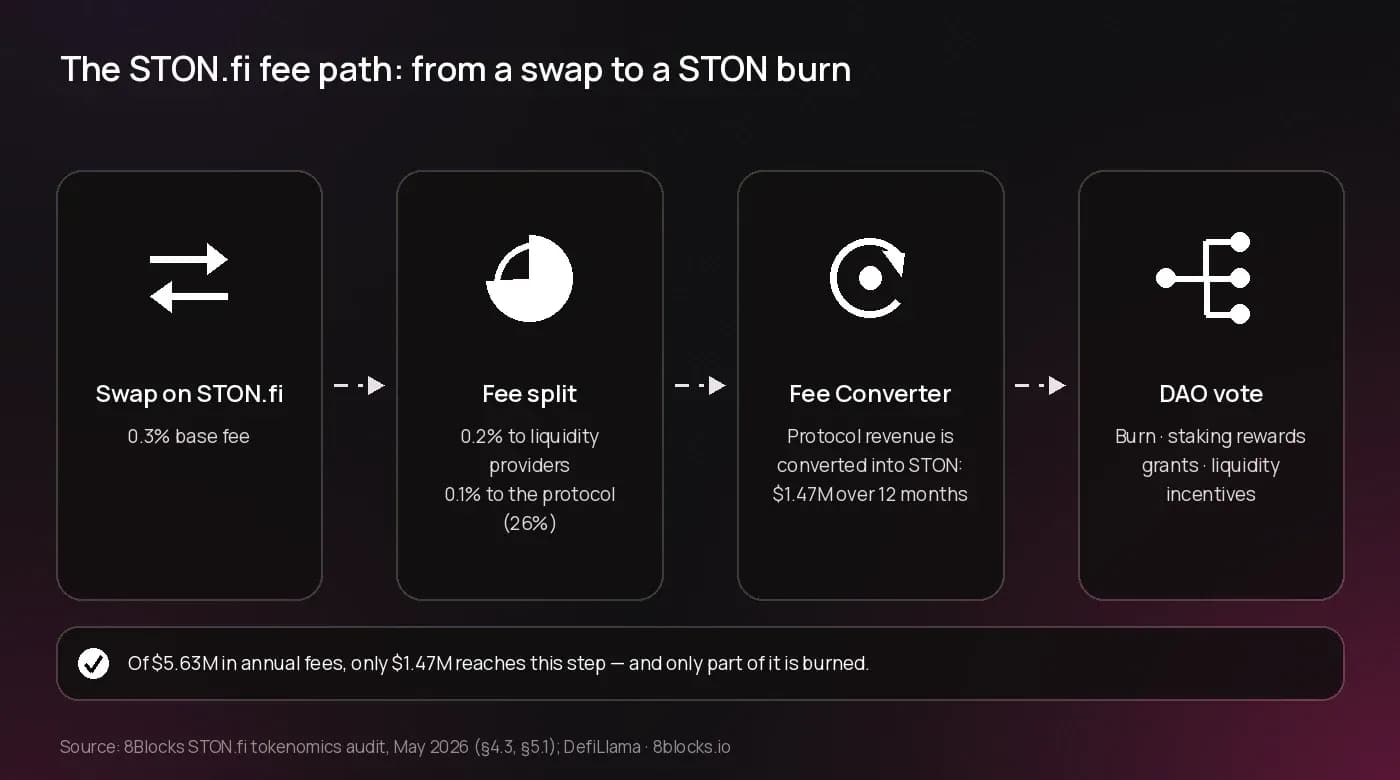
The STON.fi fee path from a swap to a STON burn. Source: 8Blocks audit §4.3, §5.1; DefiLlama.
How much buy pressure can $1.47M a year create?
At most 4.7% of market cap per year — and in practice far less. STON's market cap is $30.9M (CoinGecko, 20 August 2026). If the DAO converted 100% of the $1.47M annual protocol revenue into STON and burned all of it, that is 4.7% of the market cap in annual buy pressure. Over the last 30 days, protocol revenue was $84K — roughly $2,800 a day of potential bid against a $30.9M float. The DAO also routes part of the converted STON back into staking and farming rewards, which returns tokens to circulation instead of retiring them. Treat any "buyback and burn" narrative as a percentage-of-market-cap calculation before treating it as a price driver.
Why the "$1.2M in monthly fees" number needs context
The often-quoted $1.2M month was a peak, not a run rate. STON.fi collected $1.24M in fees in May 2026 on $331M of volume — the month the 8Blocks audit was taken (DefiLlama). The surrounding months look different: $392K in April 2026, $435K in June 2026, $435K in July 2026. The trailing-twelve-month average is roughly $470K per month, of which about $122K per month is protocol revenue. When you model a token on fee capture, use the trailing average and the protocol share, not the best month and the gross number.
Why STON's price decoupled from STON.fi's usage
STON's price stopped tracking STON.fi's usage because the product never required the token. A trader swaps on STON.fi without holding STON. A liquidity provider earns the 0.2% LP share without holding STON. Governance, staking, and fee conversion all reward people who already decided to own STON; none of them convert a user into a holder.
The price history reflects that. STON launched at its June 2023 TGE, peaked at $32.65 on 12 April 2024 during the TON ecosystem hype cycle, and fell through 2024–2025 to an all-time low of $0.2843 on 10 October 2025 (8Blocks audit). It trades at $0.44 today — down 98.7% from the high and 44% over the last 12 months (CoinGecko).
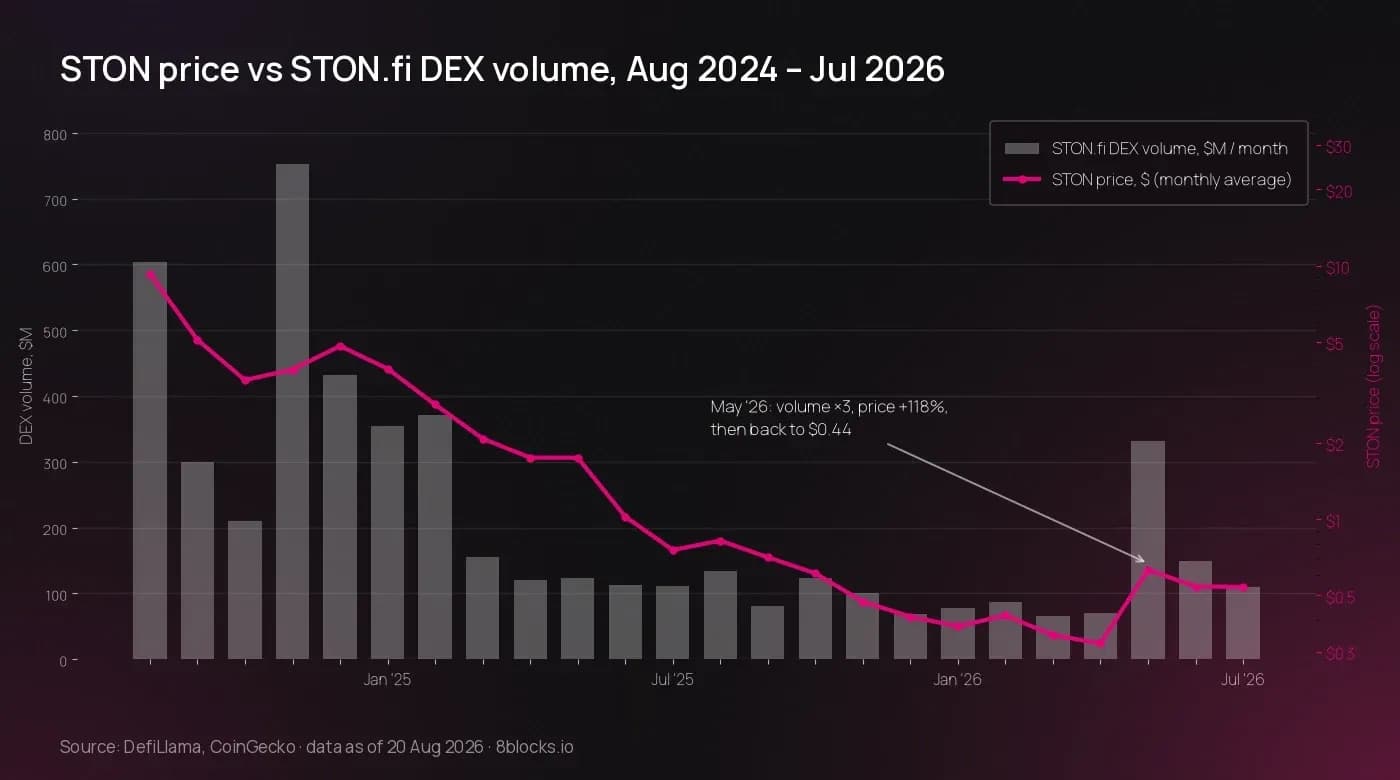
STON price vs STON.fi DEX volume. Source: DefiLlama, CoinGecko, 20 Aug 2026.
What happened during the May 2026 volume spike?
STON.fi's best month in a year moved the token, but the move did not hold. In May 2026, DEX volume tripled to $331M and fees hit $1.24M; STON rose from roughly $0.35 to $0.77 (DefiLlama, CoinGecko). The catalyst reported at the time was news around Telegram and Pavel Durov taking a larger role in TON, not fee capture. By August 2026, volume had normalized to about $110M per month and the price was back to $0.44. A token whose rallies are driven by ecosystem headlines and whose fee capture is 26% of a $5.6M pool will keep trading on narrative, not on revenue.
How STON's supply schedule adds to the pressure
STON's total supply is capped at 100M with no further minting. Allocation: DAO treasury 50%, early investors 31% (pre-seed 21%, private 10%), team and advisors 19% (team 14%, advisors 5%) (8Blocks audit, §3.1).
The scheduled emission profile from the audit's vesting tables:
| Period | Monthly unlock | What is unlocking |
|---|---|---|
| TGE (Jun 2023) | 6M at once | Marketing 2M, Operations 4M |
| Months 1–12 | ~0.49M | Marketing, operations, incentives |
| Months 13–24 | ~1.99M | + pre-seed, private, advisors (1.5M/mo) |
| Months 25–36 | ~2.57M | + team (0.58M/mo) — peak pressure |
| Months 37–48 | ~0.85M | Team, operations, incentives |
| Months 49–60 | ~0.27M | Operations, incentives |
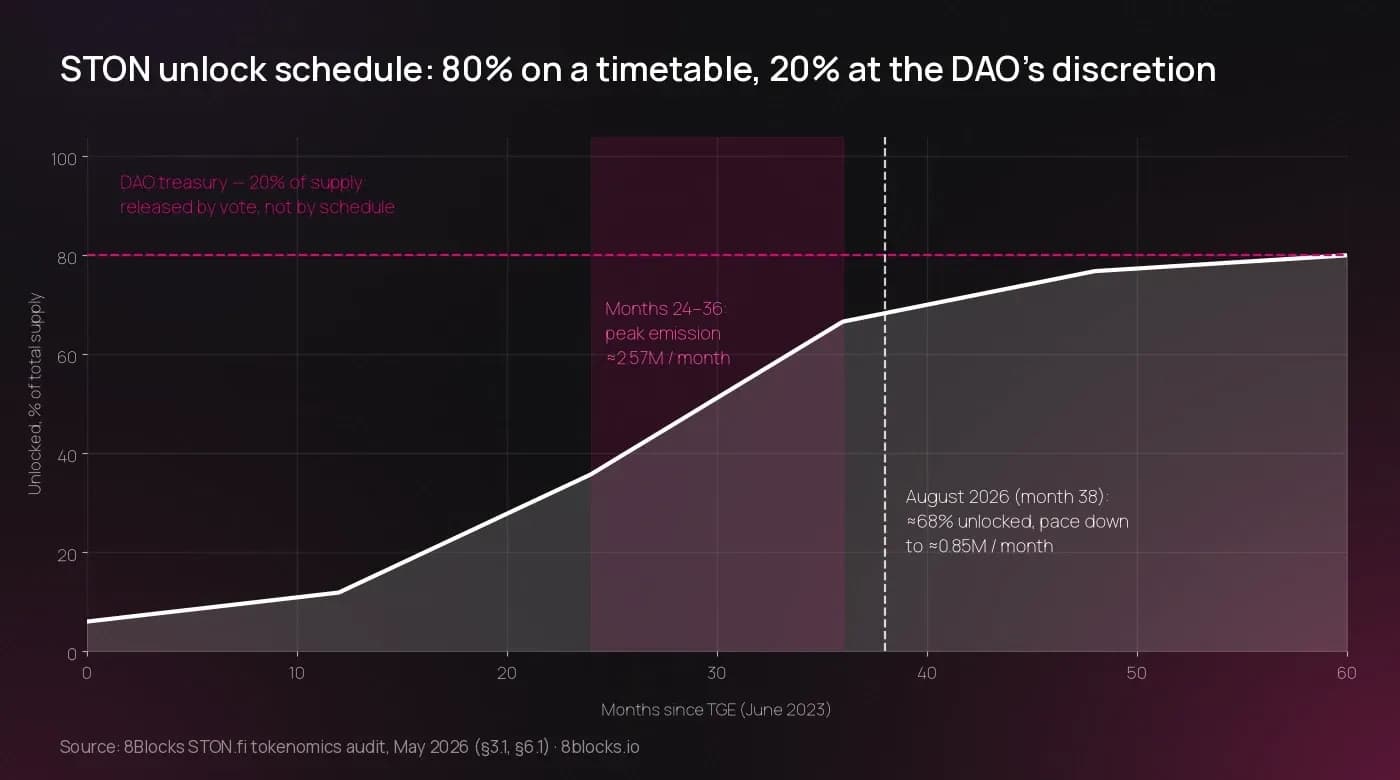
STON unlock schedule. Source: 8Blocks STON.fi tokenomics audit, May 2026.
Which unlock windows still matter in August 2026?
The worst window is already behind STON. The months 24–36 overlap — investor vesting, team cliff expiry, and DAO treasury flexibility at once — ran from June 2025 to June 2026 at roughly 2.57M STON per month. As of August 2026 (month 38), scheduled emissions have stepped down to about 0.85M per month, and roughly 70.5M of 100M tokens are already circulating (CoinGecko). Scheduled supply pressure falls again to ~0.27M per month in June 2027 and ends in June 2028. The remaining supply risk is no longer the vesting calendar — it is the DAO treasury.
Why the 50% DAO treasury is both the strength and the risk
Half of STON's supply sits in the DAO treasury, and its release is a governance decision rather than a schedule. 50M STON (50% of supply) is allocated to ecosystem development, incentives, marketing, and operations; 20M of it was locked in a 24-month staking commitment that has now matured (8Blocks audit, §3.1 and §4.1). Community control over half the supply is unusually favorable compared with insider-heavy cap tables, but it means circulating supply is set by votes, not by a published calendar. The audit's recommendation is specific: quarterly spending caps, timelocks on large decisions, streamed rather than lump-sum payouts, and a public treasury dashboard.
What STON staking and farming actually change
STON staking locks tokens for 3–24 months and mints two derivatives 1:1: ARKENSTON, a soulbound NFT that carries DAO voting rights and is burned on unstaking, and GEMSTON, a liquid engagement token whose issuance scales with lockup length (up to 1:1 at 24 months). The DAO itself committed 20M STON from the treasury to a 24-month staking lockup (8Blocks audit, §4.1).
Farming works on a different axis: liquidity providers stake LP tokens in farms to earn incentives on top of pool fees. It attracts liquidity to STON.fi, not ownership of STON.
STON.fi's users walk past the token gate: the product does not require STON.
Do ARKENSTON and GEMSTON create real demand for STON?
They create retention, not acquisition. ARKENSTON and GEMSTON give existing holders reasons to lock rather than sell, which removes supply from circulation temporarily. Neither gives a first-time STON.fi user a reason to buy STON: governance rights and engagement points only matter to someone who already owns the asset, and the audit notes that the economic value of both derivatives is itself set by future DAO decisions (8Blocks audit, §6.2). Staking postpones sell pressure; it does not manufacture buy pressure.
What would turn STON into a required asset
The fix is not more utility — STON has utility. The fix is putting STON on the path a trader already walks. The 8Blocks audit's recommendations, in priority order:
- Put STON inside the trading flow. Fee discounts for STON holders and stakers, boosted farming for ARKENSTON holders, priority access to new pools and features, and better terms for STON-paired liquidity.
- Fix the fee pipeline in writing. Publish exact percentages: X% of protocol fees converted into STON via TWAP, Y% burned, Z% to incentives — with the burn share rising when the 30-day TWAP falls.
- Discipline the treasury. Quarterly spending caps, timelocks, streaming payouts instead of one-off tranches, OTC or TWAP execution for large transfers, and a public dashboard.
- Give the derivatives real jobs. Spending and burning mechanics for GEMSTON; fee discounts, grant priority, and vote-weight boosts for long-lockup ARKENSTON.
- Pay incentives for outcomes. Reward retained liquidity, sustained volume, and long-term holders rather than temporary farming participation.
- Clean up the documentation. The whitepaper states two different linear vesting periods for the team pool (24 months in the table, 3 years in the text), which makes independent supply forecasts unreliable.
8Blocks rating: 63/100 (BBB)
| Block | Weight | Score (0–5) | Contribution |
|---|---|---|---|
| Token-Product Linkage | 40% | 2.9 | 23.2 |
| Tokenomics Sustainability | 20% | 2.8 | 11.2 |
| Fundamentals | 15% | 3.9 | 11.7 |
| Governance / Control Risk | 10% | 2.6 | 5.2 |
| Security | 10% | 4.1 | 8.2 |
| Market Layer | 5% | 3.2 | 3.2 |
| Total | 100% | — | 62.7 → 63/100 (BBB) |
STON scores well on security and fundamentals and poorly exactly where the money is: the 40%-weighted Token-Product Linkage block. That single number is the article in one line — a working DEX whose token is optional.
Key takeaways
- Fee capture is a fraction, not a headline. STON.fi users paid $5.63M in fees over 12 months; $1.47M (26%) reached the protocol; the theoretical maximum burn is 4.7% of market cap per year.
- Optional tokens decouple. STON.fi's product works without STON, so protocol market share does not convert into token demand.
- The unlock cliff is behind, the governance risk is ahead. Scheduled emissions dropped from ~2.57M to ~0.85M per month after June 2026, but 50% of supply is released by DAO vote, not by calendar.
- Retention is not acquisition. Staking and ARKENSTON/GEMSTON hold existing holders; they do not create new ones.
- The fix is placement, not invention. Fee discounts, formalized burn percentages, and treasury limits turn an optional token into a required one.
FAQ
What is STON.fi?
STON.fi is an automated market maker and decentralized exchange on the TON blockchain, and the largest DEX on TON by TVL ($25.6M, DefiLlama, 20 August 2026). It offers swaps, liquidity pools, farming, staking, DAO governance, and the Omniston routing aggregator.
Why has the STON token fallen while STON.fi stayed the top TON DEX?
Because STON is optional. Traders and liquidity providers use STON.fi without buying STON, so protocol usage does not create direct token demand. Fee capture is indirect: 26% of trading fees reach the protocol and the DAO decides how much of that is burned.
How does STON's buyback and burn work?
Protocol fees (0.1% of the 0.3% swap fee) are collected, converted into STON by the Fee Converter, and distributed by the Fee Distributor according to DAO parameters — some burned, some paid out as staking rewards, liquidity mining, and grants. The split is a governance decision and can change.
What are ARKENSTON and GEMSTON?
Both are minted 1:1 when STON is staked for 3–24 months. ARKENSTON is a soulbound NFT that carries DAO voting rights and is burned when the stake is withdrawn. GEMSTON is a liquid engagement token whose issuance scales with lockup length, up to 1:1 at 24 months.
How much of STON's supply is still locked?
About 70.5M of the 100M capped supply is circulating (CoinGecko, 20 August 2026). Scheduled vesting continues at roughly 0.85M per month until June 2027, then ~0.27M per month until June 2028. Beyond that, releases from the 50% DAO treasury depend on governance votes.
What score did 8Blocks give STON?
63/100, letter rating BBB, in the May 2026 tokenomics audit. The weakest block is Token-Product Linkage at 2.9/5 with a 40% weight; the strongest is Security at 4.1/5.
About 8Blocks
8Blocks is a token economy design firm working with Web3-native teams and Web2 businesses entering Web3. Since 2017, the company has designed tokenized economic systems where the token functions as part of the business model rather than a standalone asset. 8Blocks delivers tokenomics design, strategic consulting, tokenomics audits, and launch strategy, connecting business modeling, token mechanics, and investor materials into one coherent model.
Planning a token launch or trying to fix an existing model? Talk to us about a tokenomics audit, or model your own supply and demand assumptions in the Token Lab calculator.
Disclaimer
This content is provided for informational and educational purposes only. It does not constitute investment, financial, legal, or tax advice, and is not a recommendation to buy, sell, or hold any token or digital asset. Market data is accurate as of 20 August 2026 and will change. Token design does not guarantee any financial return, token price performance, or regulatory outcome. Crypto assets carry a high risk of loss. Readers should conduct independent research and consult qualified legal and financial advisors.
Virtuals Demonstrates How a Thriving Protocol Can Still Leave Token Performance in the Dust
Virtuals has done particularly well at enabling users to generate income via its AI bots. Ironically, the protocol’s success and VIRTUAL token’s price have become decoupled, and interest in holding has been replaced by incentives, as the potential for supply flooding looms.
What Drives DASH Coin Demand? A Look at Real Utility
Dash is a rare success story as it combines sustainable coin demand with real utility. It demonstrates how hype and incentives fall short. Dash has achieved this via collateral requirements, decentralized infrastructure, data services, and treasury independence.
When the Product Grows but the Token Doesn't
A token loses value when it stops being part of the product and becomes nothing more than something to trade. A tokenomics audit identifies that gap: it shows why users need the token, how it creates demand, how it behaves on the market, and which mechanics prevent it from working as a real asset.