2025: analysis of FDV changes across 542 tokens in the first 90 days after listing
For many years, getting listed on Binance was considered going “happily ever after” for any crypto story, but 2025 interrupted that story with bitter demise. We analyzed 542 launches on top exchanges, and we were shocked by what we found: the more prestigious the platform, the higher the likelihood it had of an 80% collapse. 8Blocks takes us through this phenomenon in their study.
Brief summary
- The average FDV change 90 days post-listing was: -14%.
- 79% of tokens’ prices declined.
- 22% of projects crashed by more than 80%.
- And only 21% managed to preserve or increase their capitalization after listing on an exchange.
In other words, four out of five tokens dropped practically to nothing within three months following their exchange debuts.
About the study
Every cryptomarket cycle shapes the same beliefs: listing on a major exchange is a marker that the product is high-quality, high FDV is evidence of potential, while fund backing is a signal that growth is afoot.
However, it is after they list that the market first starts putting the durability of those expectations to the test. The token encounters real demand, liquidity, unlocks, and investor behavior. This is where the theoretical valuations for the project end. Its market efficiency starts to be revealed.
The problem is the industry usually focuses on individual success stories. Projects that show multi-fold growth after listing become all the rage in discussion, since most of the rest remain outside the lens of the public eye.
So, rather than zeroing in on individual cases, we’ve decided to look at the market as a whole.
The study analyzed 542 listings on six popular centralized exchanges: Binance, OKX, MEXC, Gate.io, BingX, and LBank. Meanwhile, stablecoins, RWA tokens, index products, leverage tools, and other assets were excluded from the sample. This is because there are specific factors that define their performance.
FDV was the metric adopted as the benchmark
In crypto, everyone is obsessed with the current token price. But that falls woefully short when it comes to coming up with a real valuation for a project. A token with a cost of $0.01 may be more overvalued than a token with a cost of $100. Market capitalization also often distorts the story, especially when most of the supply has not yet been released into circulation.
FDV allows us to see the valuations that the market is pricing into the project, taking into account all future token supply. Consequently, this metric better reflects investors’ expectations and the potential risk of overvaluation. Here’s an example:
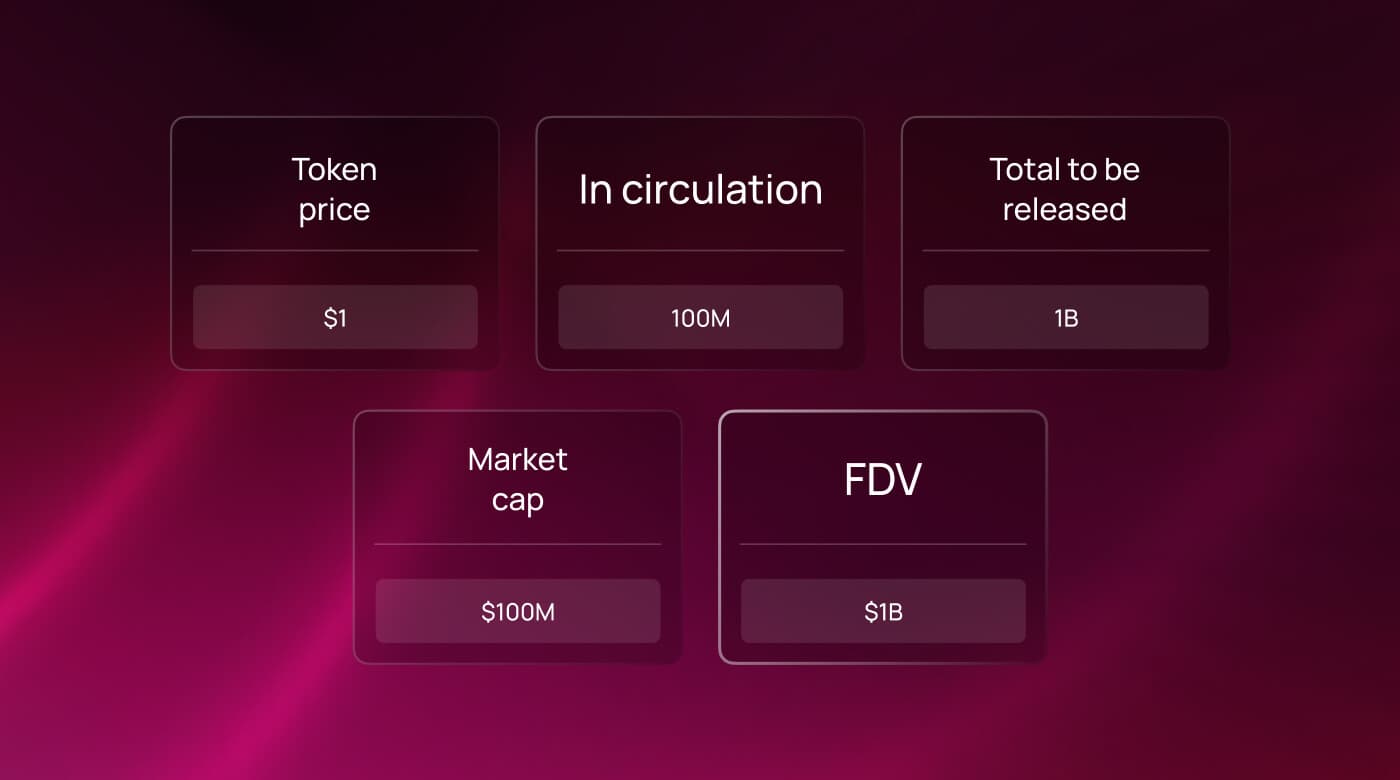
Judging by its current market cap, a project may look like a midget. But via FDV, the market could already be sizing it up as a giant. It’s as if they’re looking at a billion-dollar business, as opposed to an early-stage team with unproven economics.
And as soon as token unlocks take place, that illusion quickly vanishes. Instead of flashy charts and promises of growth, what they’ll end up with is sell-offs, price pressure, and paltry demand.
Part 1: What the FDV analysis showed
FDV reflects expectations that the market prices into a project at the time of listing. So, as a next step, we decided to check how well those expectations were linked to the token’s subsequent performance.
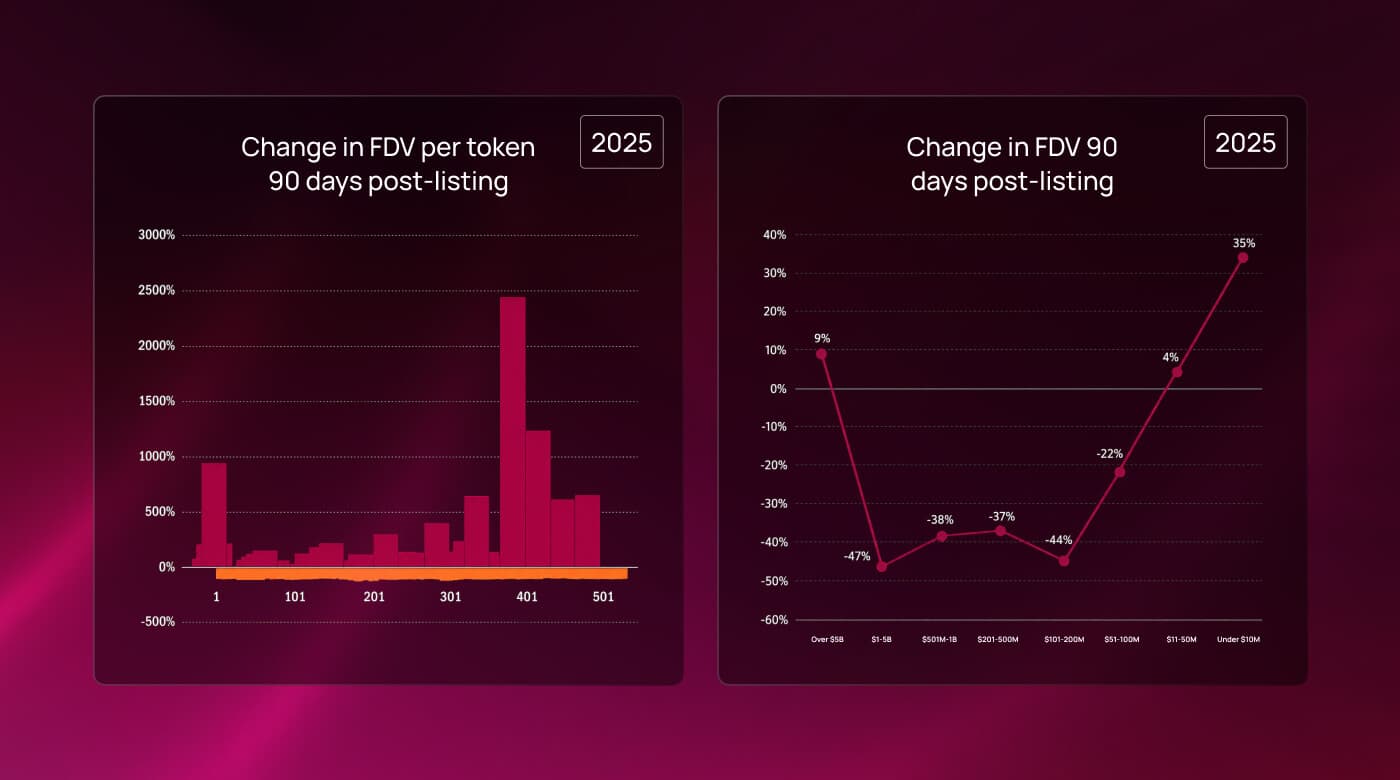
To do so, we split up all 542 projects into several groups based on their FDV size as of their listing dates: from projects valued at less than $10 million to tokens entering the market with an over $5-billion valuation.
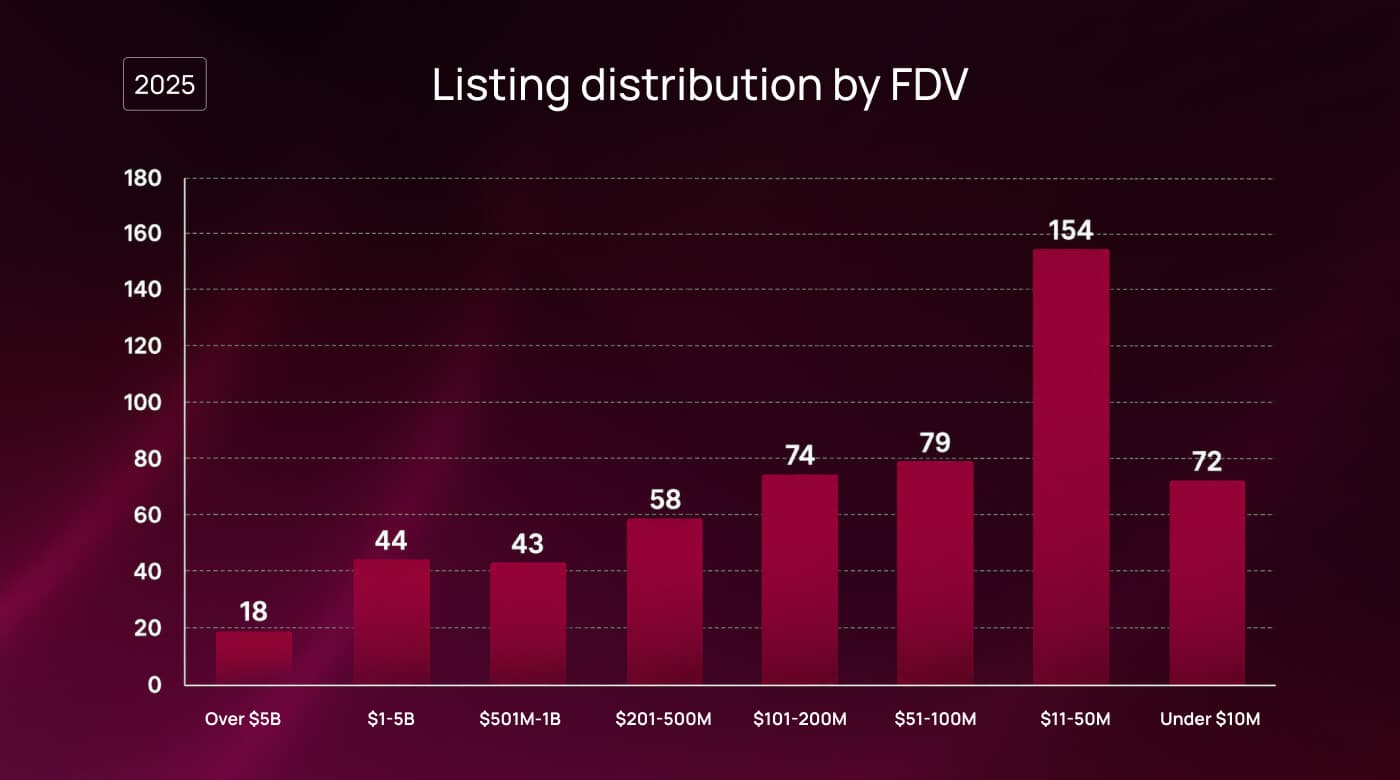
Then, for each group, we calculated the change in FDV 90 days after trading began. The first several days of trading are often accompanied by speculation, low liquidity, and sharp price fluctuation. This period isn’t very suitable for an objective judgment of tokenomics quality and demand.
Three months is more instrumental in gaining a stable feel. By then, the market has managed to digest the initial hype, the first token unlocks come out, and investors start evaluating real project results rather than the team’s promises.
This allowed us to answer one of the most important questions for investors and founders: whether a high starting valuation truly helps a project grow after listing, or, conversely, whether it becomes a risk factor.
The results we came up with were quite unexpected.
Low FDV outperforms high FDV
Formally, the most popular category has been projects with an FDV in the $10-150M range (28% of all launches). However, it was tokens with a fully diluted valuation of below $10M that rose to the top of the pack in profitability terms. They averaged +35% at the 90-day mark after trading was launched.
For project founders, that’s critical. Over the past few years, the race for maximum pre-listing FDV was heavily promoted – figures in the billions served as a badge of pride and a marketing anchor. But today, the market systematically interprets a high pre-trade valuation as elevated-risk.
Here’s what the investor is thinking: with an FDV in the billions, there’s no longer any clear route to achieving tenfold growth. However, projects starting out with a $5-10M jump out to the naked eye.
Why listing kicks off crashes, and how it’s linked to FDV
Before listing, a token exists in a relatively closed-off environment. There’s a team, funds, early investors, partners, market makers, and a loyal community. The price at this stage is often set by targeted agreements: it may vary for different participants, but the market doesn’t see these terms. For the external market, the only price that exists is the one publicly stated by the issuer.
Post-listing, however, the token first faces the open market for the first time. This moment triggers a reality check on whether the project’s valuation matches genuine market demand.
If the project enters the exchange with a moderate FDV, the market is usually able to digest early investor sales. The potential for growth appears realistic, and investors see room for the market cap to continue to grow larger.
But the higher the starting FDV, the harder it is to justify such a valuation. The market doesn’t understand whether the project truly is worth that much money. And at that moment, several investor pressures suddenly materialize:
- Early investors want to take profits: They got involved long before the TGE. And they didn’t do so because of the vision, but to enjoy returns and then eventually exit.
- Communities that waited for the launch for years finally got their tokens: And most of them start to sell them because their fear of losing out on profit is stronger than their belief in the tokens’ long-term growth.
- It turns out that the real demand for the token is much lower than was presumed during the financing rounds. The project team talks a good talk about utility and the ecosystem, but the market doesn’t understand why anybody should actually buy the token right now.
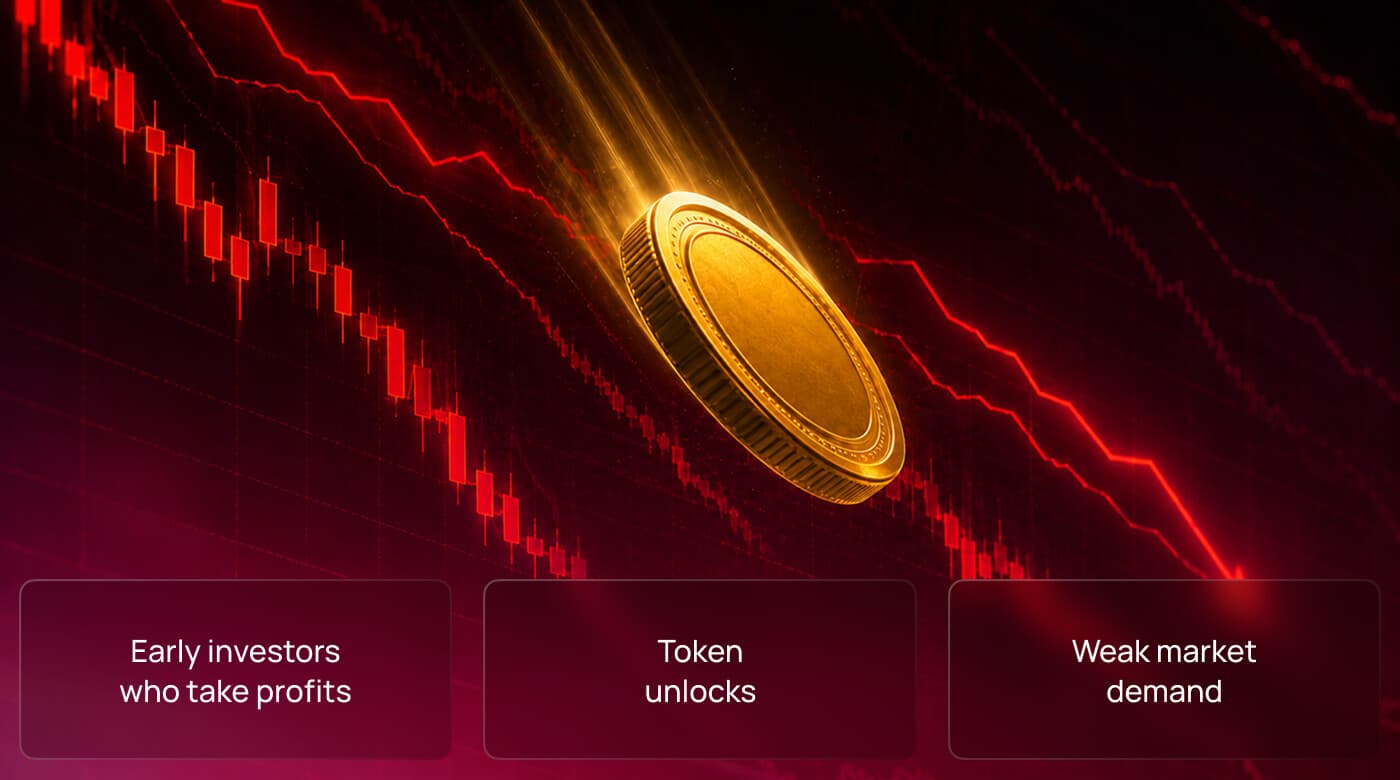
Real demand turns out to be an illusion, and the token drops. It’s the inevitable reckoning for inflated expectations that the market didn’t back.
Part 2: What the exchange analysis showed
A comparison of the exchanges revealed the difference in the numbers, but not in the trend: regardless of the platform, most tokens go into the negative after listing.
MEXC: the largest sample
Here, we analyzed 231 listings. 90 days pods-listing. By that time, 48 tokens had experienced growth. In other words, that’s 21% of the projects. The remaining 183 had dipped below their starting valuation.
This result almost completely matches the average for the entire study. So MEXC can be viewed as a good proxy for the general market performance: about one in every five tokens retains or increases their market cap after listing, while most of them take losses.
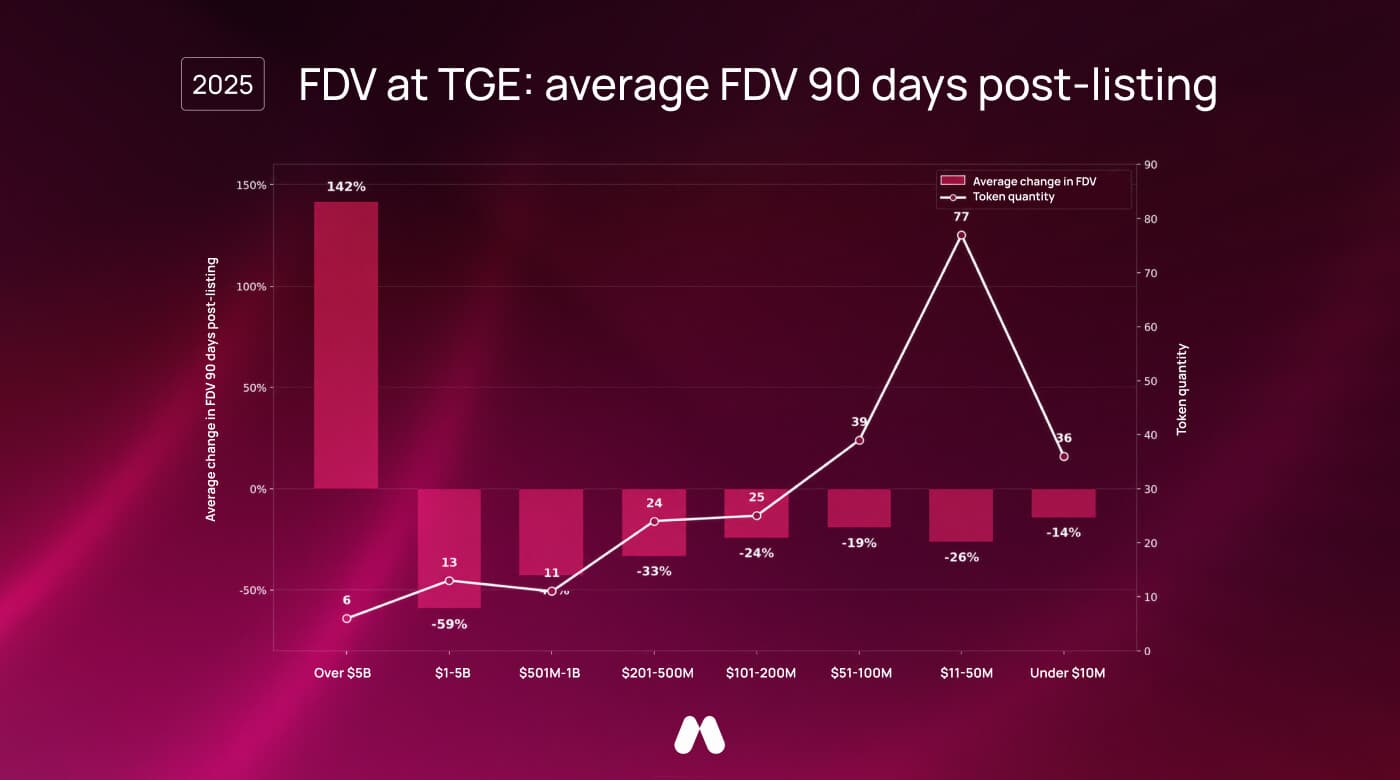
An interesting anomaly appeared in the projects cohort with an FDV of above $5 billion. There, average growth was 142%. But it would be a mistake to conclude on that basis that “very expensive projects on MEXC grow”. Only 6 tokens fall under that group, which means that one or two strong cases could’ve significantly distorted the average.
Gate.io: meager performance across almost all cohorts
We analyzed 97 listings on Gate.io. Only 9% of tokens showed growth 90 days later, and this is one of the paltriest showings in the study.
Projects with an FDV of $201 to $500M suffered an especially sharp decline: with an average change of -82%.
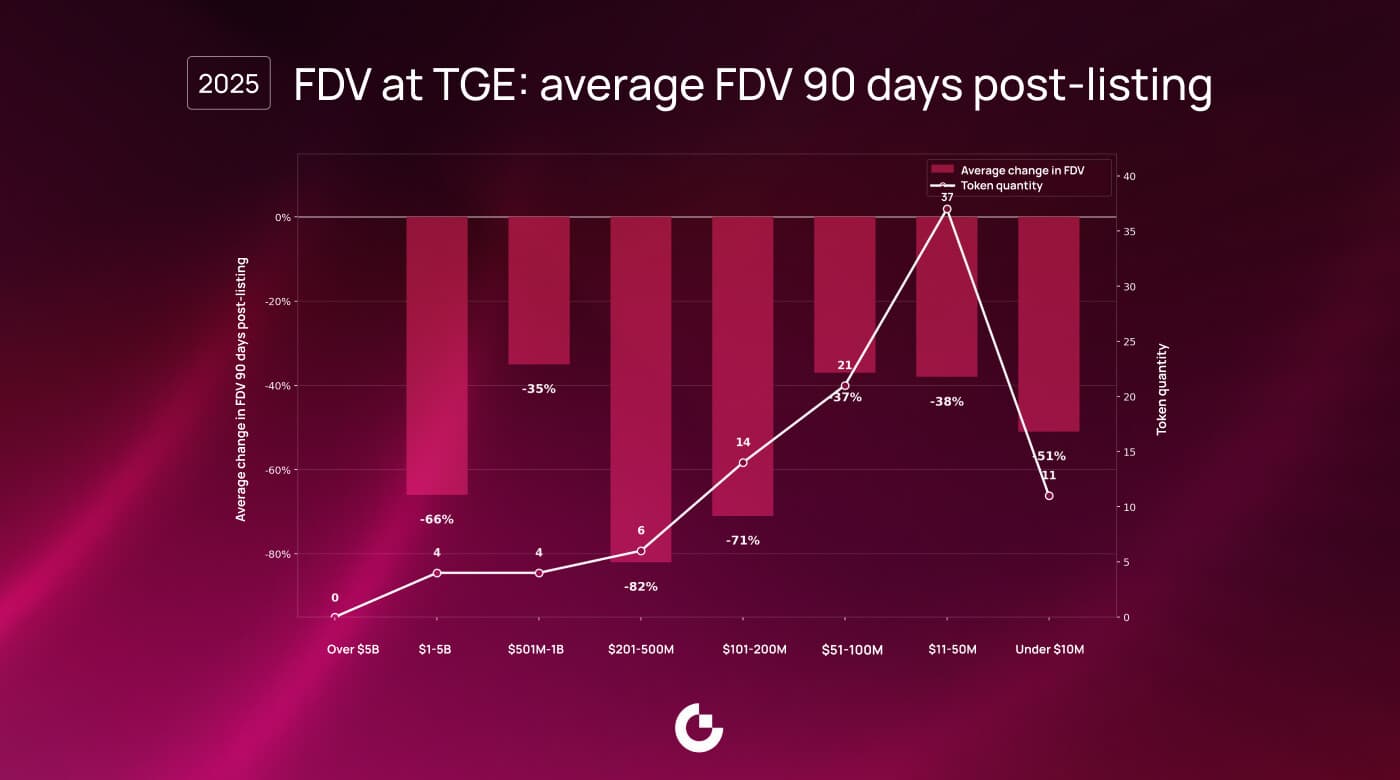
This data obliterates the popular misconception that the main risk zone is limited to projects with multibillion-dollar valuations. In practice, even FDVs in the several hundreds of millions of dollars don’t guarantee stability post-listing.
BingX: encouraging result, but small sample size
BingX exhibited one of the best performances in terms of the share of growing tokens it has had. Out of 35 listings, 10 projects enjoyed growth 90 days post-listing. This is good for 29% of the sample.
What’s especially fascinating is that the $201 to $500M FDV cohort came out on top: average growth posted 13%. This is a rare case where projects with an average valuation in that range have gained.
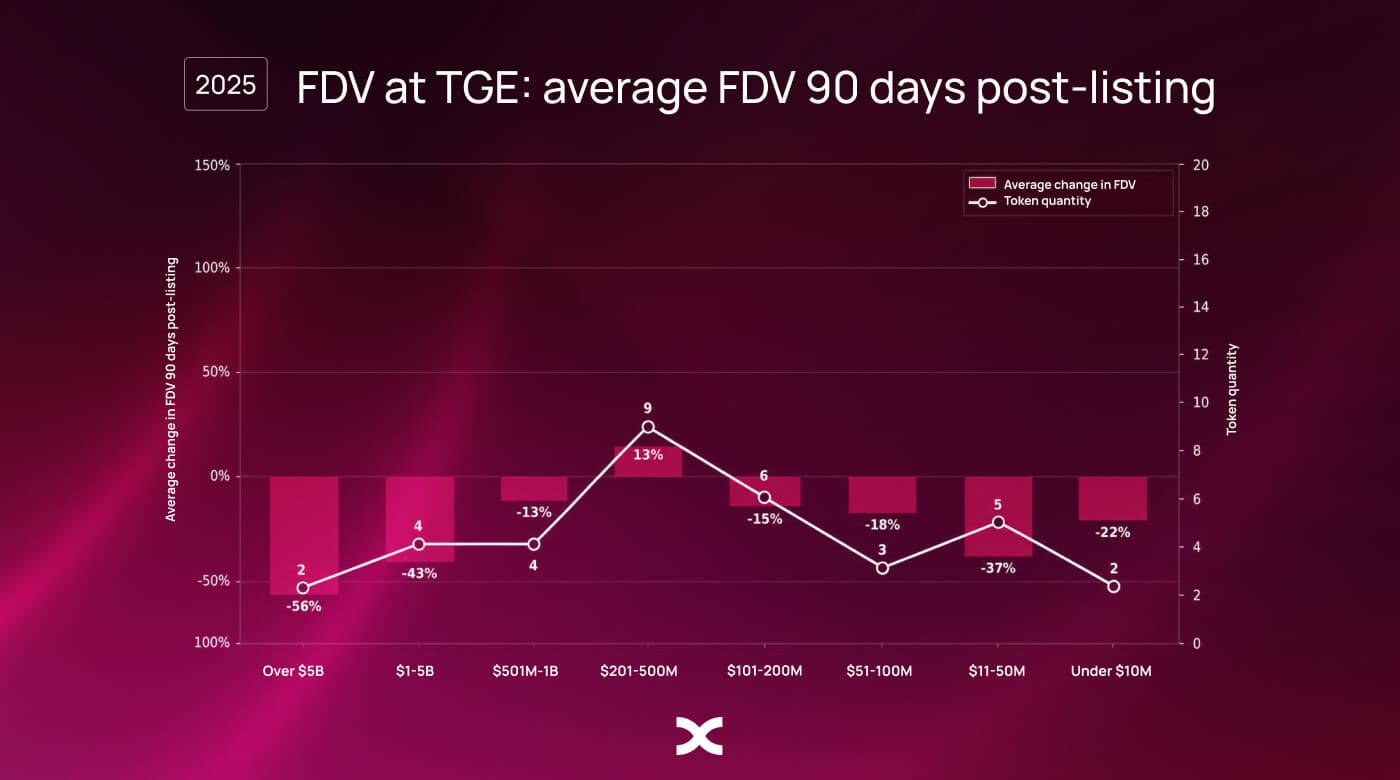
But it’s important not to overstate this showing. The sample size is small. Thus, this data on BingX yields more of a hypothesis than a universal rule. It’s possible that the platform may truly have selected projects better during this period. On the other hand, it’s also possible that this result was achieved merely through a few strong cases. The data here is insufficient for a firm conclusion to be made on the market as a whole.
Binance: the top exchange doesn’t guarantee growth
Binance yielded the most telling result of all.
15 listings were analyzed on the exchange. By 90 days post-listing, only a single token exhibited growth, while the remaining 14 ended up with lower valuations than they started out with.
Furthermore, not a single FDV cohort managed a positive average return. Projects with an FDV of above $5 billion and in the $201 to $500M range experienced an especially sharp drop.
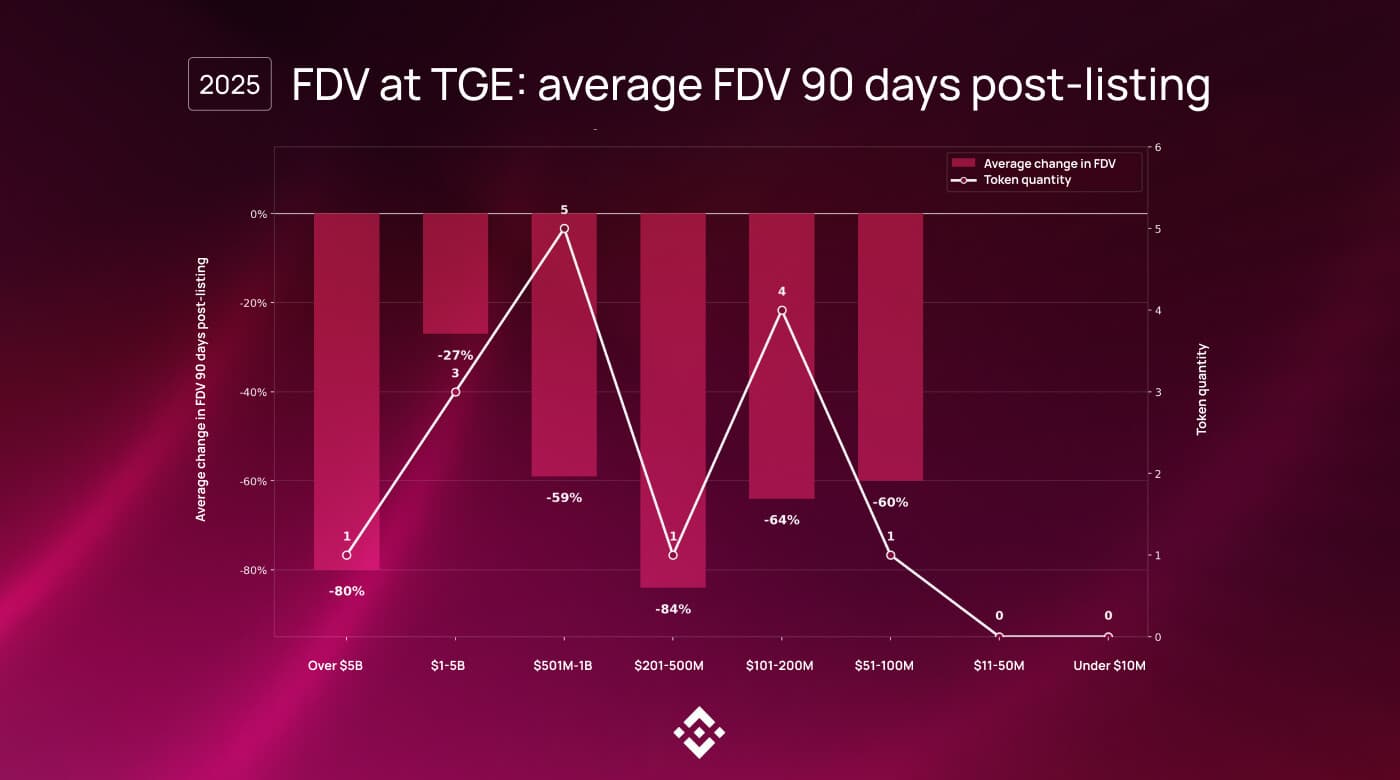
This is an important signal to the entire market. For a long time, listing on Binance was thought of as a hallmark of quality and all but an automatic growth driver. But the data shows that today, listing on Binance is ever more often perceived as a point of peak expectations now, and no longer so much the beginning of upward movement.
By the time it goes public on a large exchange, a project may already be overhyped by funds, marketing, the community, and retail expectations. In this scenario, listing turns into a moment of truth rather than a starting line. And if there isn’t enough real demand, the market quickly demonstrates that the previous valuation was overblown.
OKX: the worst result in the sample
None of the analyzed listings exhibited growth 90 days post-listing.
The sample size is small, and it’s premature to make any final conclusions about the exchange as a whole. But the fact itself is telling: even a large, big-name platform doesn’t guarantee a project success after listing.
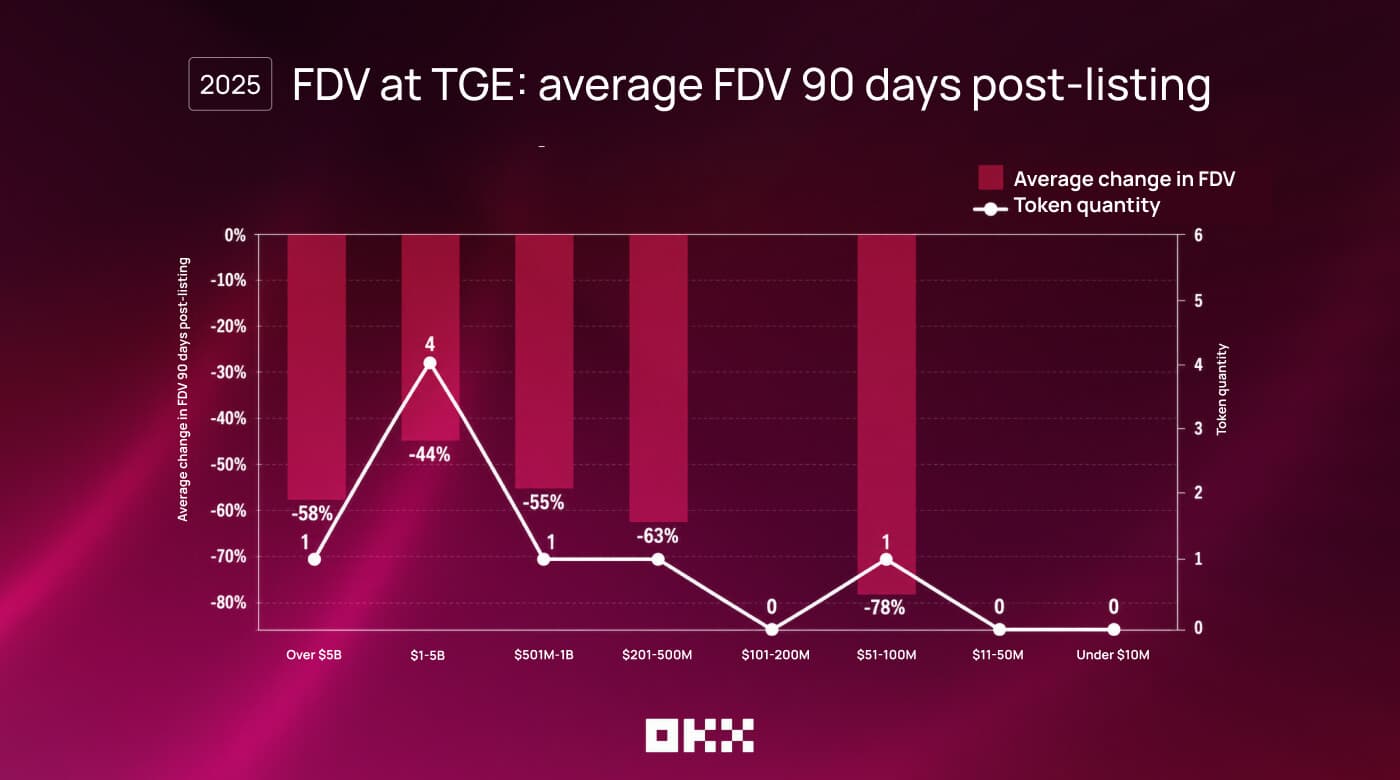
This serves to confirm the general conclusion of the study. An exchange provides liquidity, reach, and access to an audience, but it doesn’t create stable demand automatically.
LBank: the surprise leader of the study
The most potent performance was displayed by an exchange that was by no means the largest. 31% of tokens that launched on this platform showed market cap growth 90 days after listing.
The results enjoyed by low-FDV projects are especially impressive:
- under $10M: 157% growth;
- $11 to $50M: 120% growth.
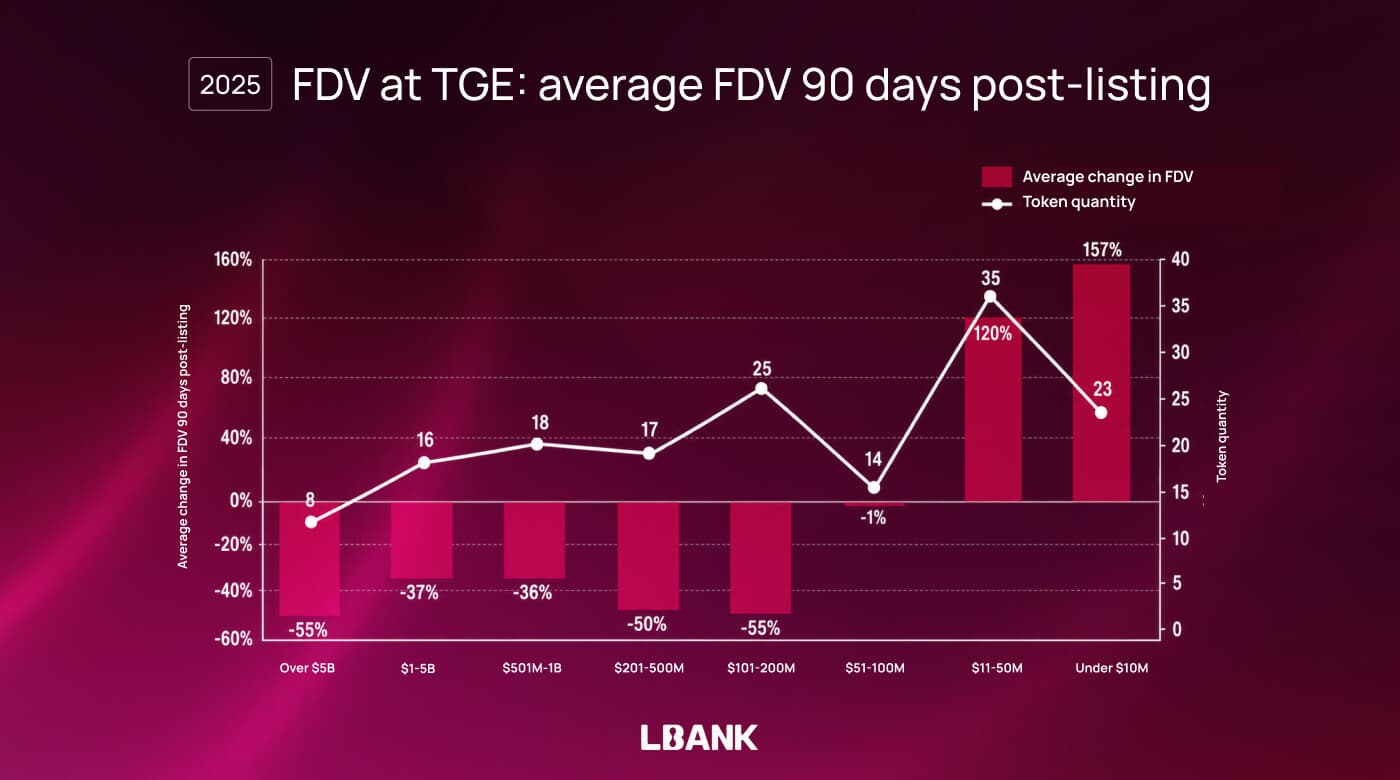
The reason most likely doesn’t have to do with the exchange itself, but the composition of the projects. Most of the time, it’s small teams with modest starting valuations that end up on LBank. It is precisely those projects that are demonstrating the best performance right now.
Important note: this isn’t evidence that exchanges are degrading
Quite the opposite: today, it is projects with the maximum investor attention, large financing rounds, and high market expectations that make it onto the largest platforms. But the bar that a project needs to clear after listing has grown alongside that.
Therefore, the paradox of the modern market is that the direct connection between listing prestige and potential returns is fading ever more often over time. Making it onto a top market remains an important achievement for a team and a strong signal of a project’s maturity; however, it by no means guarantees growth for investors in and of itself.

In fact, the market has grown more discerning. Whereas previously the status of being on a platform could maintain interest in a token for a long time, today investors can distinguish how promising a project is from the quality of the exchange it’s trading on much quicker.
Therefore, the primary conclusion of this study isn’t about exchanges but about the market: the era when listing was considered an argument for investment in and of itself is coming to a gradual end.