Crypto Token Deflation: a Crash-and-Burn Strategy
Deflation is a common practice to bolster a crypto token’s value, which achieves the opposite effect. This short-sighted view restricts opportunities for benefits, acceleration, and problem-solving. Furthermore, tokens behave differently from money and are much less stable. Developers must pursue true utility and functionality before focusing on simpler tactics like scarcity and marketing.

We’re all very familiar with the way inflation works in ordinary fiat currencies. Governments print out heaps of new bills in order to stimulate and add liquidity to the economy. Then milk and eggs start to cost more, and many perceive it as worsening the economy.
So the logic follows that all you have to do is limit and reduce crypto tokens’ supply through deflation. Makes sense, right? Not so fast. First of all, you don’t have the same kind of control as a national central bank of a fiat currency. On the contrary, the current of your deflation is amidst the vast ocean of the larger crypto market. Some of the holders of your tokens, crypto “whales” can also flip deflation on its head.
A fatal detail that issuers miss, however, is that crypto tokens aren’t money, aside from a minority of them, which are cryptocurrencies. Rather, what they effectively are is goods – goods which only hold value insofar as they are useful. Rather than attempting to reactively and artificially bolster a token’s value, the surest way to achieve the goal is through true value and utility.
Deflation vs. inflation: purchasing power

To grasp its significance with digital tokens requires first understanding how it compares to inflation. Imagine a simplified closed system where there is a fixed balance between money and goods. Suppose you have 100 units of money and 100 units of goods. (100:100 ratio). In that case, each unit of money corresponds to one unit of goods.
Inflation
If the money supply then increases to 1000:100, there is now a lot more money directed at buying the same amount of goods. A lot of people are willing to pay a premium just to get it since the good grows scarce. As a result, each good grows more expensive in nominal terms.
Deflation
Now, say the money supply is 100 compared to the supply of the good – 1000. Now, the vendors just want to sell off their goods because nobody is buying. Hence, the purchasing power of the population rises.
What deflation means for tokens in practice
Even in the realm of ordinary central bank policy for national currencies, deflation is considered more damaging to an economy than inflation. For all of its criticisms, inflation is intended to do a lot of good for the economy. It helps achieve a number of ends, such as issuing loans for new homeowners and business startup hopefuls. Even though the value of the dollar or the Indonesian rupiah does go down for every other dollar printed, the economy receives a myriad of additional benefits, which help strengthen the economy overall by accelerating the usage of that currency.
Here are some commonly mentioned ways:
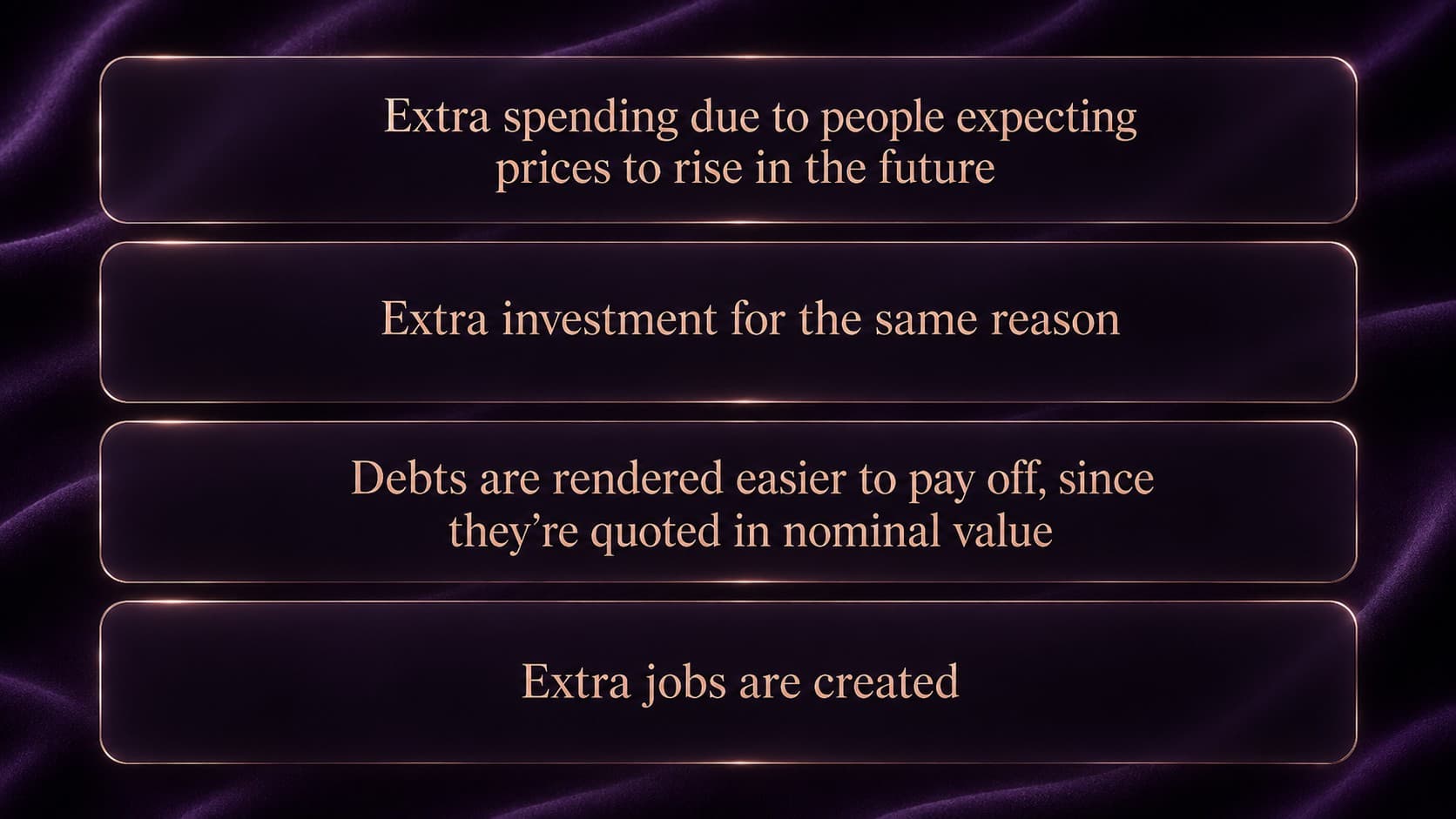
How this manifests with tokens
When project developers issue batches of crypto tokens, they do so with very specific angles in mind for the promotion and popularization of the tokens. Some of them are designed to simply be held and traded just for their value alone. Examples are the Bitcoin and the Doge Coin; however, even these are prone to contractions, such as the Bitcoin collapsing to $87,000 last year, and this is the most prominent such token.
Projects that do not operate mainly around strictly limiting the total supply of the token enjoy many advantages that end up bolstering tokens’ value. Such projects actually fully expect and embrace inflation, because it allows them a lot of options to do many things to inject practical, real value into the tokens.
First of all, the extra tokens issued render a lot of transactions cheaper, such as:
- Peer-to-peer payments
- Mining
- Staking
- Services
Furthermore, since token owners already know that they are about to fall in price, they have no incentive to hold onto them. This stimulates people to use them and exchange them, which then enhances their utilization and therefore – their value. But this is only if they truly are effective in their design.
How token deflation is carried out
There is a number of ways deflation is performed, but none of them yield much benefit. It’s normally done in the following two mechanisms.
Burning
This entails just taking some of the tokens out of circulation by sending a portion of those tokens into a dead-end crypto wallet that will be forever encrypted so that nobody can attain them. They’re effectively “gone”.
Halving
Here, miners and stakers are deliberately demotivated from creating new tokens. One way this is done is by cutting the rewards in half that miners can attain every particular number of years. It is a great incentive that halts the production of the token.
Utility deficit: why token deflation is a dead end

Even when it comes to real currencies, the true determinant of value, crypto market volatility aside, is the need to acquire that particular currency to be used for something. That’s the key reason that deflation is a road to nowhere fast.
The only end that deflation theoretically achieves is value storage. The problem with that is it demotivates individuals from actually putting those tokens to use. It is commonly inconvenient to use them or try to acquire them. Thus, the economic activities surrounding them stagnate, and that creates a burden on the growth and success of the token.
Flexibility
The same thing occurs in national economies when central banks try to bolster their currencies' values through deflation. The job market and investments tighten, since it’s more difficult and there’s a lack of desire to carry on transactions. This is why it’s viewed as harmful even in the more stable world of fiat currency, where national currencies hold monopolies.
One big problem with deflation though is that once the circulation supply is reduced, it doesn’t come back. If you produce a lot of tokens in a more inflationary scenario, this problem can still be addressed – you can always apply deflationary practices, if you ever did see the need, on the tokens that are out there.
How to create demand through scarcity
If reducing supply doesn’t solve the problem, then the focus has to shift to what actually matters – demand. Not artificial demand driven by narratives or temporary hype, but real, sustained demand coming from genuine utility.
This can happen in one of two ways:
- A large number of users each has to need a small amount of the token, or
- A smaller group of users has to need a significant amount of it.
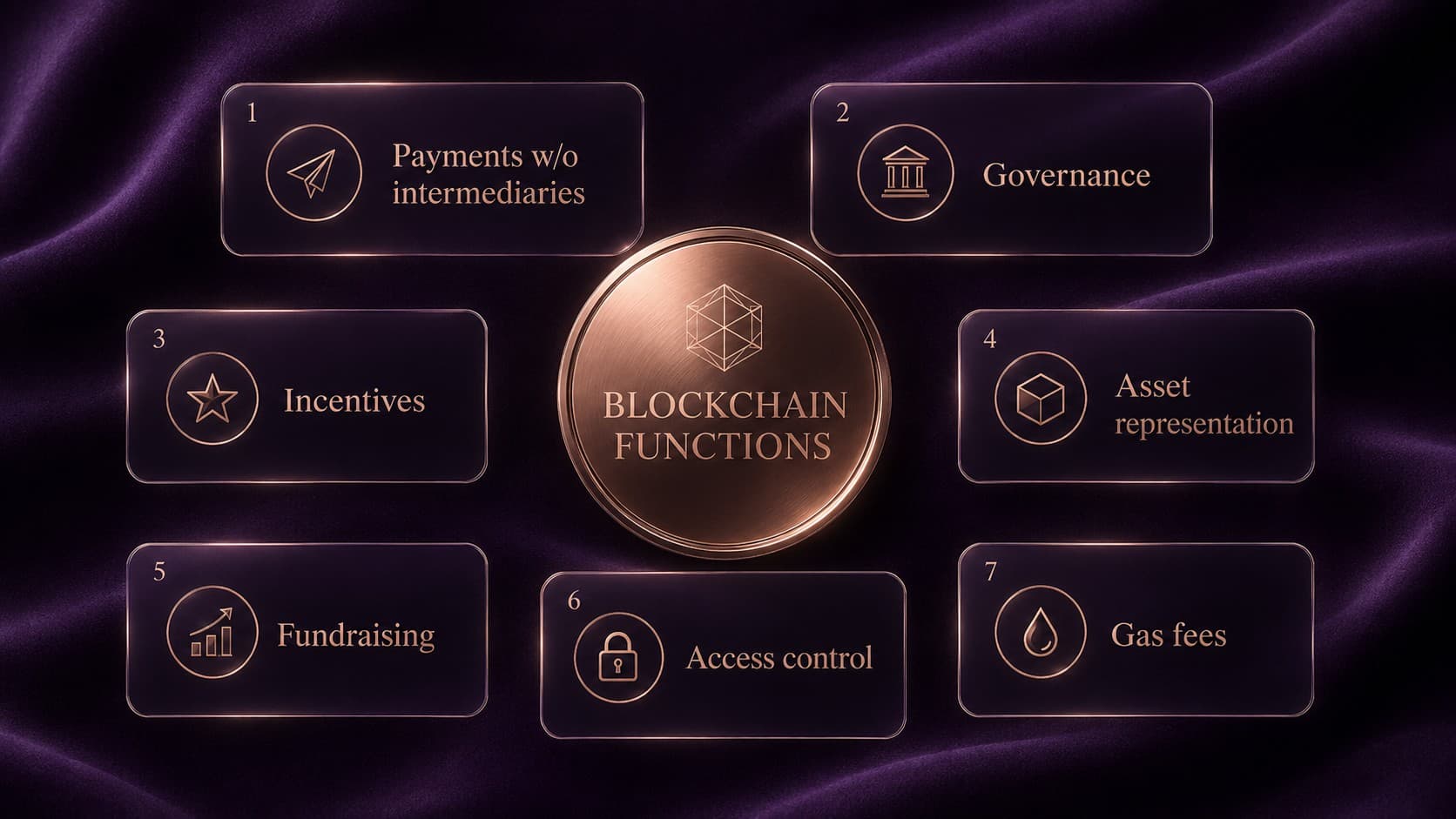
Both models can work, but only if the need is real and occurring. Here are some common ways that token gains demand, each of which deflation would work against:
- Exchange media: payments cutting out the intermediaries
- Access to services like gas fees, computation, or access
- Governance and voting
- Incentives
- Asset representation
- Fundraising
- Identity and credentials
Real scarcity
If users can achieve the same outcome without a particular token, demand will always be weak. This is why benefit and innovation are central. Demand must be structural, not optional, as well. Tokens that people just hold only struggle to maintain value, while tokens, for instance, that are necessary for interaction within an ecosystem naturally accumulate demand over time.
Once you’ve built something that truly solves a problem or delivers value with the token playing an essential role in that, then you can start to apply other mechanisms like scarcity and advertising to enhance such perception.
Conclusion
Deflation in crypto promises a simple shortcut to value: reduce supply – increase the price. But that logic only works out in theory, and even then, only under very specific conditions. In practice, most tokens aren’t money, and cutting their supply does not render them more useful, more necessary, or more valuable. Even real currencies under such a context will wither due to the impediment of their usage.
What actually determines a token’s success is not how many units exist, but whether anyone actually needs them in the first place. Without real demand, deflation is just optics. With real demand, scarcity emerges naturally – and that’s what drives price.
Burning tokens is easy. Building something people genuinely want to use is not. And in the long run, only one of those strategies actually works.
FAQ
Does reducing the supply of a particular token inherently increase its price?
It does not. This will only increase the price if demand stays the same or grows. If demand is weak, it will have little effect on value, and hamper its utility.
Why is deflation often promoted in crypto?
Because it’s simple to understand and easy to market. In reality, there are deeper forces at play though beneath the surface.
What determines a token’s value?
Primarily supply, demand, and scarcity. Demand is the key, and it stems from the actual benefits a token offers and the problems it solves. It must stand out in some way that matters to a particular group of people.
Why can deflation be harmful to a token ecosystem?
It can discourage usage. If users expect a price to rise, they tend to prefer to hold onto it, rather than spend it, which reduces activity and slows ecosystem growth.
What is a better alternative to deflation-focused tokenomics?
A utility-driven model that creates constant demand. Once demand exists, scarcity can be introduced naturally – without relying solely on supply reduction.
Are all crypto tokens affected by deflation in the same way?
No. Tokens that function as currencies may respond differently from utility tokens, which behave more like products. The majority of tokens fall into the latter category.
When the Product Grows but the Token Doesn't
A token loses value when it stops being part of the product and becomes nothing more than something to trade. A tokenomics audit identifies that gap: it shows why users need the token, how it creates demand, how it behaves on the market, and which mechanics prevent it from working as a real asset.

The 5 Most Common Tokenomics Mistakes and How to Avoid Them
Most tokenomics mistakes happen before launch, while the team still has time to fix them. The problem is rarely one wrong formula. It’s the lack of a system: the token should be part of the business model, not a separate asset attached to the product at the last minute.
What Drives DASH Coin Demand? A Look at Real Utility
Dash is a rare success story as it combines sustainable coin demand with real utility. It demonstrates how hype and incentives fall short. Dash has achieved this via collateral requirements, decentralized infrastructure, data services, and treasury independence.