Why HYPE Appears to Be Stronger Than Most DeFi Tokens, and at What Point That Power Could Run Out
HYPE is a good example of the kind of tokenomics that forms when a token doesn’t drift away from the product but rather is built into its economy instead. But beyond that, there’s something more significant this case sheds light on, that being – even a functional model generating substantial revenue and clear demand may remain reliant on specific continued conditions, rather than possessing an absolute margin of safety.
HYPE has everything going for it to be considered one of the strongest DeFi tokens out there. It’s backed by a working product, racking up lots of revenue, extensively utilized, and operates a buyback program that’s built into the platform’s economy. But there’s more that’s worth reviewing in these models other than their qualities alone. Another fascinating aspect of them is peering into what exactly is maintaining their stability and where they may hit a limit.
In this article, we are going to break down what’s caused HYPE’s rise to the top relative to most DeFi tokens, what in this model has worked out better than in so many others, and why even this case shouldn’t be regarded as free of all vulnerability.
Why HYPE appears to be one of the most compelling cases in DeFi
There’s something HYPE has that’s missing in so many DeFi tokens. It doesn’t exist as separate from the product.
It’s not the kind of scenario where a token is living a life of its own, as the platform lives another. It’s not the kind of case when it’s expressly outlined in the documentation how it’s intended to be utilized, even though, in reality, it practically doesn’t have any influence on anything. With Hyperliquid, you can sense there’s a much sturdier relationship between the product and the token.
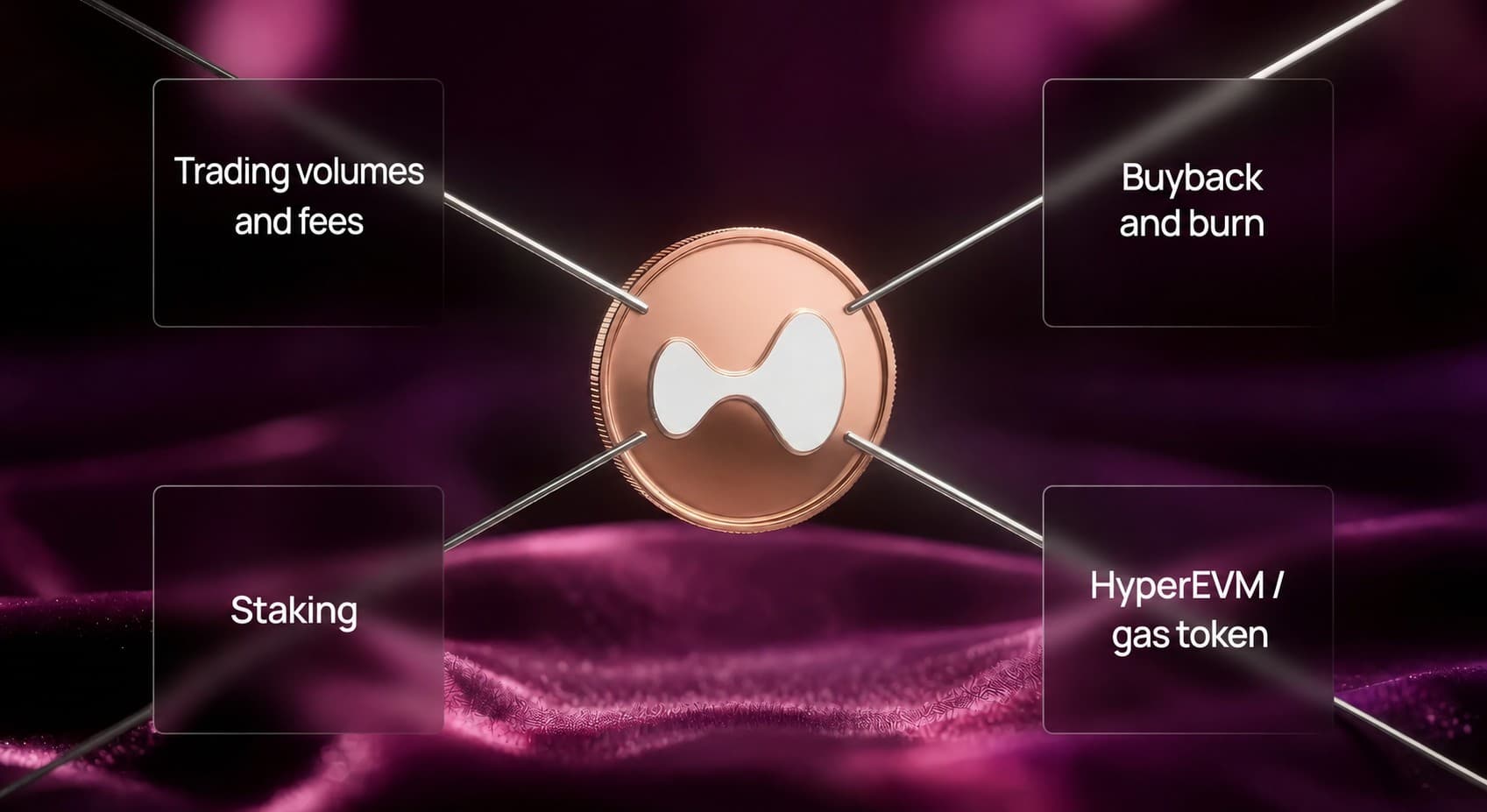
First of all, the demand for HYPE is anchored in what’s going on inside the platform. When trading volumes accelerate on Hyperliquid, the fees rise along with it. All the while, support for the token becomes bolstered as well. That phenomenon is a big deal. In many projects, it takes the market years to figure out where demand for the token is supposed to come from. At least in this project, the issue doesn’t remain up in the air.
Secondly, the buyback and burn program doesn’t resemble a merely decorative superstructure simply added for efficient tokenomics. They are built right into the platform economy and directly tied to its revenue. In other words, the market isn’t given some vague promise like “We are going to stand behind the token,” but instead, there is a working mechanism in place impacting the model.
Then there’s staking. On that front, HYPE has also demonstrated itself to be more mature than many of its analogs. It comes in handy in more reasons than the holder just having one more APR added to the interface.
Staking yields a practical benefit within the platform itself, first and foremost fee discounts for active traders. And that there is a totally different type of utility. It’s more grounded and, thus, more compelling.
There’s another important layer as well. In HyperEVM, the token operates as a gas token. That means that its role isn’t reduced to mere governance or price speculation. It’s a necessary component for actions to be able to be completed within the network. That holds more weight on the market than just another token that’s “generally important for the ecosystem,” but nothing will crash and burn if it isn’t kept on hand.
Consequently, HYPE now draws a lot more interest than most other DeFI tokens, and it’s not due to the fact that they have penned some inspiring story behind it that they tell. Rather, it’s because it’s pre-built into the platform’s economy through commissions, buybacks, staking, and its role in HyperEVM. And that’s just a foundation providing a reason to not only talk about the buzz around the token but around a model that’s truly built upon something.
Ways that Hyperliquid has outperformed many of its counterparts
Another facet of HYPE that sets it apart from the majority of other DeFI tokens is it doesn’t operate the typical time bomb of early discount rounds.
Many projects dig their own graves before the token ever manages to reach the market. First, they initiate Angel, Seed, Private, and other sales under early conditions. Then they start listing. And then they undergo a fairly predictable course of events: some of the holders end up on top even when selling below the public price, and the token experiences downward pressure almost immediately.
With HYPE, the story is quite different. The model has no hidden storehouse of coins on the part of early buyers who got the tokens at a fraction of the price and then exert downward pressure on the market at their very first opportunities to exit. And that is obviously a very important advantage. It eliminates one of the most toxic scenarios for the price during the first stages of the token’s existence. But that’s not the only thing.
The model has already shown itself in action
Hyperliquid has already undergone moments where the model was faced with the task of demonstrating whether it would work live or if it just looks nice in the description. Pressure has been brought on from airdrops, market stress, volatility, and profit taking, and the token didn’t dissipate under the very first major test.
That too demands being separately addressed. Many models look clean-cut, until the market grows and they get tested. Here, the situation is different: HYPE has already managed to endure an environment where flimsy designs usually are torn to tatters rather quickly. A separate signal is the price. The token didn’t dip below the starting range since market shocks. For the market, that’s an indicator that the model at least at the current stage is capable of withholding strain.
Where HYPE grows reliant
This aspect of HYPE is quite clearly observable.
At the current stage, the model is propelled by the fact that Hyperliquid continues to generate rather high trading revenue. That’s what supports the buyback and helps absorb new supply. While the volumes are strong, this system appears steady. But that’s precisely what creates reliance. Almost the entire logic of the token’s support is based on trading revenue. The platform channels 99% of its commissions into the buyback, and currently that’s operating as a powerful tool for maintaining the price. But the problem is that its strength directly depends on whether Hyperliquid is able to maintain its current level of trading activity.
But beyond that, there’s another factor that starts to burden this model – the rise of tokens in circulation. New tokens continue to be released onto the market, and the unlocks enhance the pressure. And the more that supply rises, the more the system has to buy just to keep up the previous balance. In other words, over time, the strain isn’t subsiding, but growing instead.
And that’s what brings us to the key issue.
What happens if the trading activity declines faster than pressure coming from new supply weakens?
In that scenario, buyback wouldn’t fully disappear, but its safety margin would no longer appear absolute. Support for the token would start to weaken faster than the market stopped receiving new tokens. That means that the model that in the strong phase appeared very strong would start to take on a totally different feel.

Why this doesn’t make HYPE a weak token
HYPE still holds onto something that a huge number of other DeFi tokens don’t. It has a product that generates income. The token has a clear role inside the ecosystem. There’s a working relationship between user activity and demand for the actual token. And there are mechanisms that have already managed to show how they play out the market.
So, we’re not talking about a flimsy design. We’re talking about a design that has certain pillars it’s dependent on. And that actually means a lot. Because there are a lot of tokens on the market that can’t say that. There need not be any discussion of the limits of their durability, since their base is too flimsy from the very beginning. In HYPE’s case, it’s a totally different scenario. The model demonstrates itself to be functional, mature, and much better thought-out than most of its analogs.
But the model being mature doesn’t make it a sure thing.
HYPE’s power does not arise out of some sort of vague “good tokenomics” but, instead, out of rather specific conditions: high trading volumes, platform revenue, use of the token inside the product, and this entire construction’s ability to continue to stomach rising supply.
What this case demonstrates to the market at large
The most significant thing about HYPE isn’t just that it’s one of the most noteworthy tokens in DeFi. It’s not even the fact that Hyperliquid has managed to assemble a working economy around it. Its most significant aspect is rather that such cases best expose how easy it is to confuse merely a good model with a model with a true margin of safety.
When the token grows, commissions are high, buyback is functional, and the product is getting utilized, it’s very easy to then conclude that everything in the design is fine. But current stability doesn’t necessarily mean that the model will hold as steady down the line. The true test begins later, right when one of the key drivers begins to weaken. That’s when you get a picture of whether the token had been just propped up during the prosperous phase or if there is depth within the model.
In that sense, HYPE is a case that serves to benefit the entire market. It demonstrates that even a token with real-world usage, functional buyback, and a strong product cannot be evaluated merely based on the way it looks at the moment. It’s important to understand what exactly is behind its stability and how reliant it is on particular facilitating conditions.
Above all, this would logically lead to the following conclusion: good tokenomics isn’t determined by how good it looks during the growth phase. Good tokenomics relies on not only having a good engine, but also a good safety margin backing it as well.

When the Product Grows but the Token Doesn't
A token loses value when it stops being part of the product and becomes nothing more than something to trade. A tokenomics audit identifies that gap: it shows why users need the token, how it creates demand, how it behaves on the market, and which mechanics prevent it from working as a real asset.

The 5 Most Common Tokenomics Mistakes and How to Avoid Them
Most tokenomics mistakes happen before launch, while the team still has time to fix them. The problem is rarely one wrong formula. It’s the lack of a system: the token should be part of the business model, not a separate asset attached to the product at the last minute.
What Drives DASH Coin Demand? A Look at Real Utility
Dash is a rare success story as it combines sustainable coin demand with real utility. It demonstrates how hype and incentives fall short. Dash has achieved this via collateral requirements, decentralized infrastructure, data services, and treasury independence.