How Will the US Treasury Buyback of Long Bonds Affect Bitcoin’s Market Cap?
On August 19 the US Treasury doubled its long-bond buyback cap — bitcoin cleared $70 000 within the hour and the market added $500b in a week. Why that was duration repricing rather than new liquidity, and what it means for a token launch.
On August 19 the US Treasury doubled the size of one routine operation. Bitcoin cleared $70 000 within the hour, and the market added $500b over the week. Nothing was printed, no reserves were created, the Fed never met. So what actually happened?
A buyback moves the maturity schedule, not the money supply
A liquidity support buyback is a narrow technical operation. The Treasury repurchases older, thinly traded government issues from primary dealers and funds the purchase with new borrowing. Debt outstanding does not fall. Bank reserves do not rise. Only the maturity profile and the going rate change.
The decision itself is small and precisely scoped. The cap on a single buyback operation rises from $2b to $4b, for paper in the 10-to-20 and 20-to-30 year sectors. The window runs from September 9 to November 4, 2026. What prompted it: a 30-year yield too high for comfort at its highest level in 19 years, debt above $40t, and a $432,3b budget deficit in July alone.
The market read the signal the same day. The 30-year yield fell 9 basis points to 5,2%, the 10-year 5,7 basis points to 4,6%.
So the transmission runs through term premium, not through money. That distinction sets everything else. When a central bank buys assets, it creates reserves and the effect accumulates slowly through the banking system. When the Treasury swaps one maturity for another, it changes the price of duration and nothing else. Effects that travel through price and positioning arrive faster, fade faster, and reverse without warning.
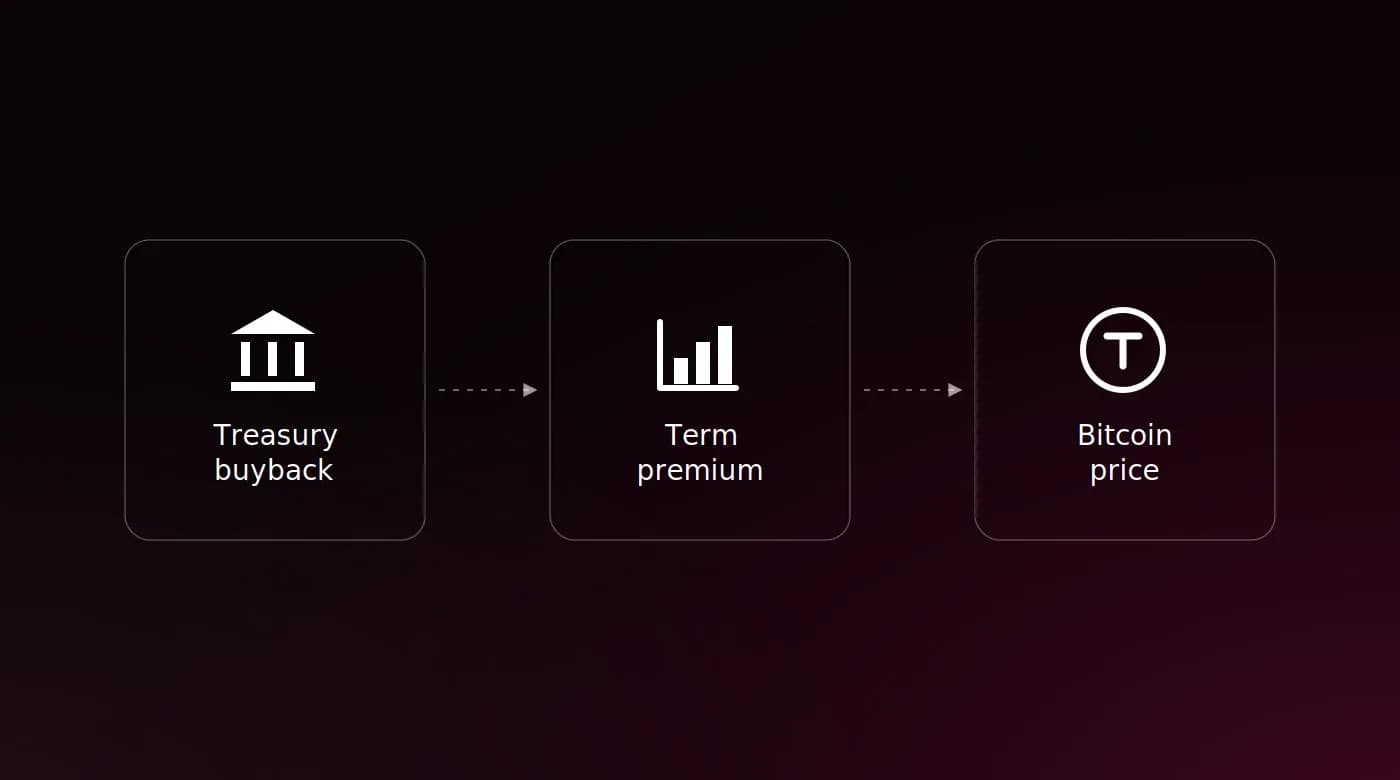
The transmission chain. It stops at the price of bitcoin
The long end moved, the on-chain dollar lives on the short end
Almost nobody draws this connection, and for a team preparing a token it matters more than the headline number.
The buyback works in the 10-to-30 year sectors. Under GENIUS, stablecoin issuers hold their reserves in paper maturing inside 93 days. These are two different ends of the same curve, and the operation touches only one. The long end got a bid. The short end, where every on-chain dollar is collateralised, got nothing.
The evidence is already visible. Stablecoin supply peaked in May 2026 and has been contracting since, the first decline in four years, while transaction volume keeps climbing. Total supply sits near $305b. Holding an on-chain dollar pays the holder nothing by statute, so capital moves into tokenised treasuries and yield-bearing wrappers instead of sitting in investor wallets.
Your token does not launch against a 30-year bond. It launches against investor liquidity. The first went up in August. The second did not.
Twenty-two percent was positioning, not repricing
Within the hour of the announcement, $1,1–1,4b of short positions closed. The same week brought a White House meeting confirming support for the sector. Two forces, one candle.
Duration repricing and an inflow of new capital look identical on a chart, but they behave nothing alike. You can tell them apart, and price plays no part in it. New capital enters crypto through stablecoin market cap, because dollars have no other door. Duration repricing enters through bitcoin and stays there.
The market currently sits near $2,7t, bitcoin near $77 400, dominance near 60%. Stablecoin supply is not growing. Read that combination the way a credit analyst would: the position changed, the capital base did not.
This bid has an expiry date
The increase runs through November 4, 2026. After that the question returns to the quarterly refunding, and nothing guarantees an extension.
Lay that date over a normal fourth-quarter launch calendar. A team that read August as "liquidity is back" and moved its TGE into November is scheduling into the week the support gets reviewed, not the week it is guaranteed. The September 16 Fed meeting falls inside the same window: in July the rate was held at 3,50–3,75% on a 9-3 vote, and all three dissenters wanted a hike.
A token with revenue and a token without react differently
Treating "crypto is going up" as a single event is the most expensive mistake in this topic. There are three channels here, and they are not equally real.
Bitcoin takes the impulse directly. It is the longest-duration asset in most portfolios, its entire value is terminal, and a change in the discount rate hits it first and hardest. That is why it moved on a Treasury press release.
A token with real protocol revenue takes the impulse indirectly. Long-end rates fall, the cost of capital for the protocol’s counterparties drops, activity follows, and revenue follows activity. The effect is real, weaker, and lagged by quarters rather than hours.
A token with emissions and no revenue has no channel at all. It trades as beta to dominance, and at 60% dominance that beta is negative. A rally concentrated in bitcoin drains liquidity out of it.
There is a fourth pressure that a move in rates does not relieve. At 3,50–3,75%, the risk-free rate has become a liquid on-chain competitor to your emissions, in a wrapper available to the same allocator. Any model paying less in real terms loses the allocation contest under every macro scenario.
Three markers that show which regime you are in
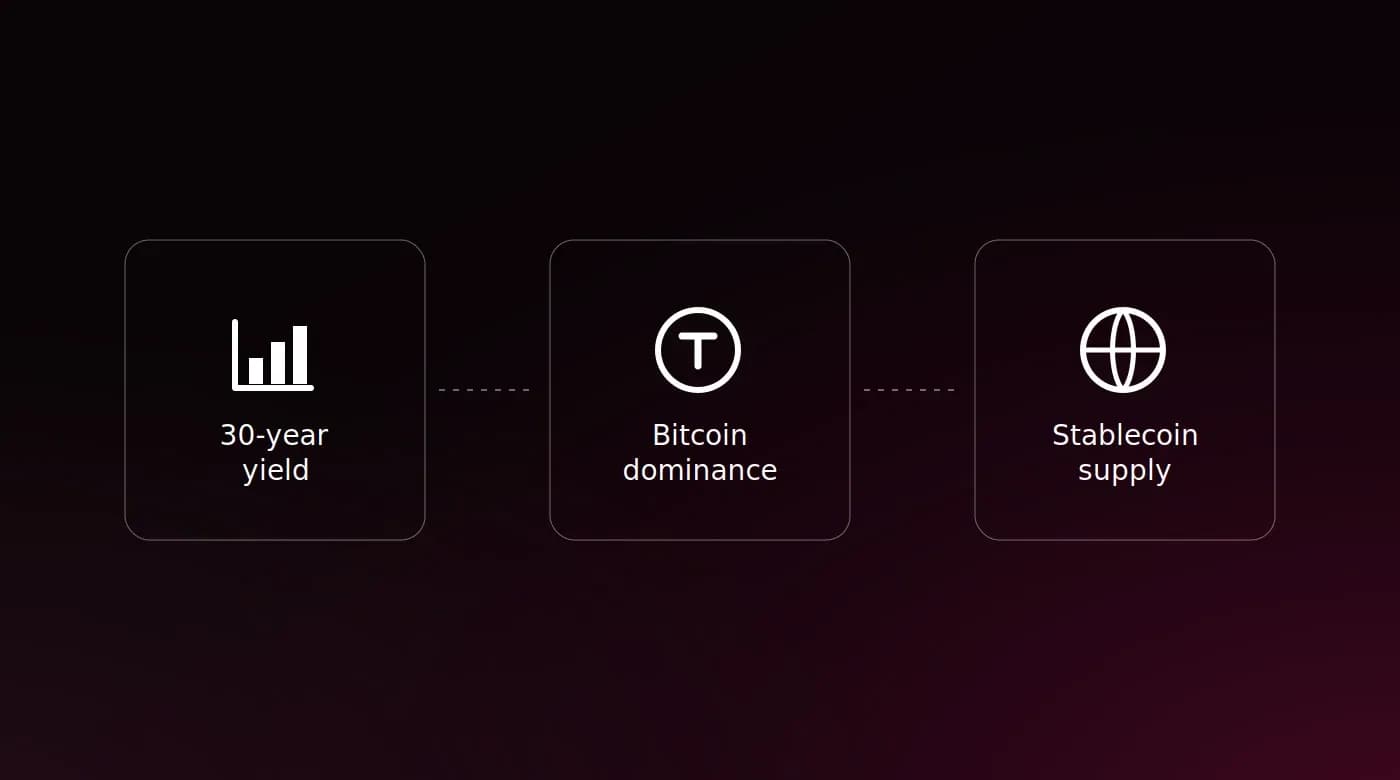
Three indicators of the same order. None substitutes for the other two
| What to watch | How to read it | What it means for a launch |
|---|---|---|
| 30-year yield after September 9 | Falling — the bid is being absorbed as intended | The duration channel is open and works until November 4 |
| Bitcoin dominance below 55% | Capital is rotating past bitcoin | The only condition under which a TGE benefits |
| Stablecoin supply resuming growth | New dollars are entering the chain | The only confirmation that carries weight. Without it, a price move is a position move |
Two of the three markers are currently negative. The third has not been tested yet.
When this conclusion does not hold
If the 30-year does not fall after operations start on September 9, the buyback has been absorbed by supply, and none of the above applies.
That outcome points somewhere else entirely. It means term premium is rising for reasons a $4b operation cannot reach, and the market is repricing sovereign risk rather than liquidity. Bitcoin can rise in that world too, but for the opposite reason: as a hedge against debasement, alongside rising yields, with gold rather than with equities. The signature of that regime is unmistakable and its consequence is blunt. Altcoins do not participate in it at all, and it helps no token launch.
All figures reflect open sources as of August 25, 2026: the US Treasury press release of August 19, same-day market reporting on the yield move, market-cap aggregators, and stablecoin supply data through July. Yields, market cap and liquidity move daily. This is an analysis of a mechanism, not a forecast and not investment advice.

Pump.fun Buys Back Half Its Revenue. The Price Is Still at Its Low
Pump.fun sends half its fee revenue into PUMP buybacks and has burned 36% of supply, yet the token sits at its all-time low. Why a buyback worth 2% of daily turnover cannot replace demand: coverage, procyclicality, optional utility and the unlock schedule.

6 Common Loose Ends That Come Back to Haunt Crypto Projects
Launching crypto tokens takes an awful lot of dedication and enthusiasm. However, it is the dullest, most obvious oversights that so often end up as their downfall. Learn about accounting for budget, timeline, audience, tokenomics, unit economics, and funding sources.
Why Tokens Drop After TGE Even When Everything Goes to Plan
A token doesn’t drop after TGE only because the product is weak, the marketing failed, or the listing went badly. In many cases, the sell pressure was built long before launch, through early token rounds. When too many cheap allocations reach the market at once, TGE doesn’t create the problem. It exposes it.