6 Common Loose Ends That Come Back to Haunt Crypto Projects
Launching crypto tokens takes an awful lot of dedication and enthusiasm. However, it is the dullest, most obvious oversights that so often end up as their downfall. Learn about accounting for budget, timeline, audience, tokenomics, unit economics, and funding sources.

So many brilliant crypto business token ideas fail to escape the runway, or curse themselves to eventual demise, all due to simple mistakes in their initial design. Unrealistic budgets and timelines, non-existent economics, premature token sales, questionable funding sources, and poor audience targeting are the biggest culprits. Accounting for these will give projects a chance to reap their full potential.
At first blush, it seems like there’s nothing to launching a crypto token project. Suppose your team develops a stunning, innovative business model, and it’s getting a lot of people excited. You whip up a whole lot of early excitement, you build your smart contracts, and you invest many hours into designing insane amounts of value into the project for as many people as possible.
However, the sad thing is that it is usually one single, meddling bottleneck in the process that tends to foil an otherwise fabulous idea, which could’ve brought so much value to the marketplace. It is for this reason that any project looking to launch does so with extensive attention to detail and a calculated schedule for each step in launching and managing a token’s state on the market. This starts with the basics.
Without further ado, now for the 6 most common details crypto projects overlook that end up blowing up in their faces.
Budget isn’t based on the real world of 2026
A lot of project developers are kidding themselves when they think they can just launch a project, à la 2018, when all you had to do was just compose a white paper and mold together a community using the very money being thrown at you by investors and then paying them back by issuing out more coins to them. The times have changed in a major way since the 2025 crypto crash.
Speculation came home to roost in such a major way that only tokens that people had an actual necessity for actually survived, most of all – tokens tied to real-world assets. So now, the standard and, thus, the competition among different tokens, has gone rife. The proposition is no longer “raise first, build later”. Now it’s become “prove traction first, then raise”.
Now, instead of speculation, we’re dealing with:
- infrastructure businesses
- venture capital
- institutional investors
- compliance
- real revenue
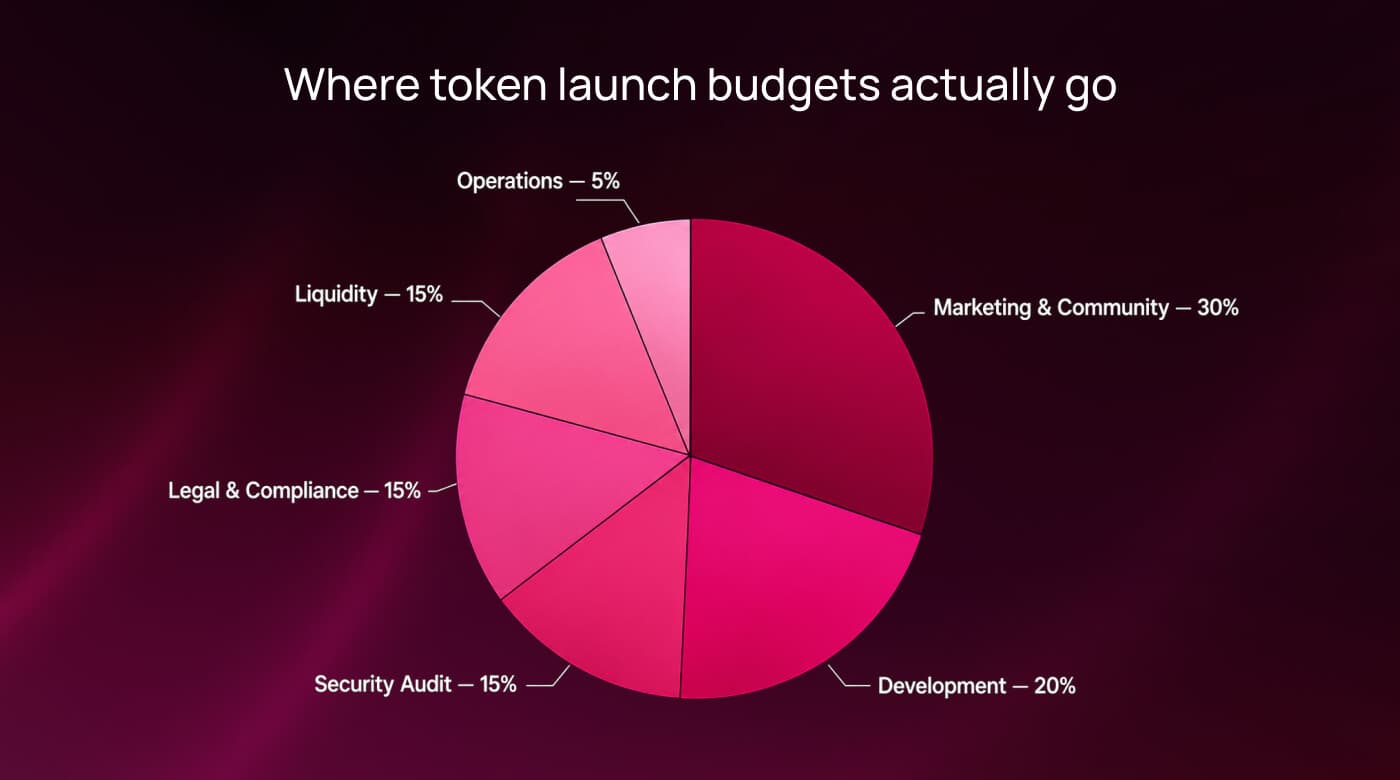
Realistic budgets
Developers often look at how much creating tokens costs and just take that at face value as how much they’ll need to set aside. For starters, you’re definitely going to have to deal with:
- auditing
- admin controls
- backend
- testing
- launch support
- hosting
- wallet integration
Even worse, when extra costs start suddenly flooding in is when businesses tend to try to cut corners. So it’s an absolute must for a business to account for all the funding it's going to need for the life cycle of the project in advance. This includes the timing of the launch, since the market conditions will heavily impact the cost of many different expenses; however, it tends to hover around $500,000.
Every project, though, has very different product logic needs. Beyond just the development of a fungible token, considerations include whether it’ll need:
- burn logic
- governance rights
- treasury controls
- vesting
- staking hooks
- presales
- referrals
- rewards
- escrow
Some projects need a full product layer. Everything nowadays though is more based around security, compliance, and usability. Since there are many competitor projects out there now and investors have undergone attrition, user expectations are a lot higher now.
Furthermore, if you plan to use a decentralized exchange, be prepared to pay just as much for maintaining liquidity as you’d have to pay a centralized exchange for listing. Otherwise, you’ll be in danger of wild price swings triggering a sell-off.
Failing to establish your timeline and capabilities
Teams tend to be way too optimistic in terms of the overall process of launching a token. Many assume that getting to TGE will take a mere three months. Fast forward several months, and they still don’t have the funding they need for promotion or the legal advice. Compliance and auditing can drag on as well. Realistically, it tends to take 12 to 18 months for an average project to get from the conception of the idea to listing.
Thus, a company needs to honestly project the entire timeline of every arrangement and preparation they’ll need to make before launching, in minute detail, in order to be best positioned with finances and the appropriate measures to be taken to avoid delay. Even in the first month, the whole project could get ruined. In light of MiCA, compliance has grown in stringency.
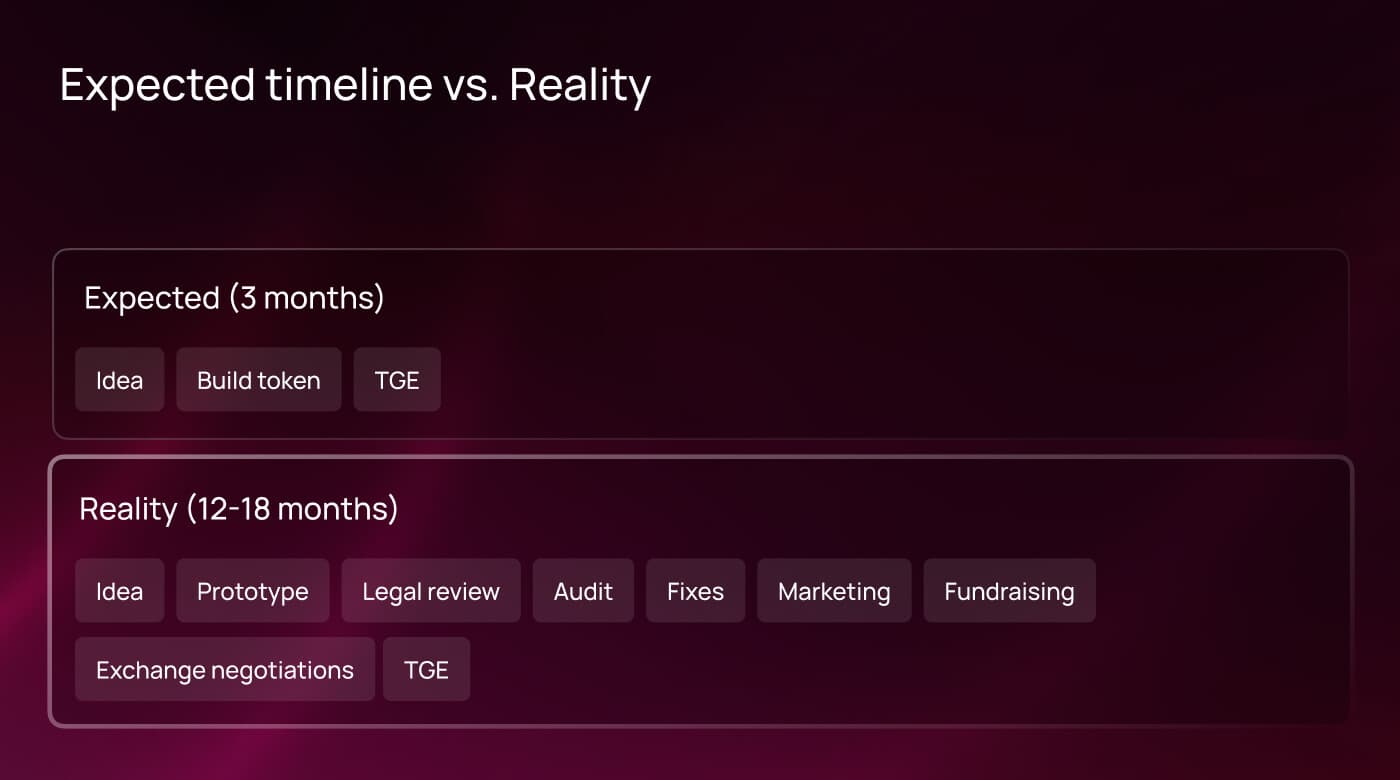
Specificity and detail
A couple things projects certainly should avoid are vagueness and overambitiousness in their planning. Milestones such as “enhance user experience” and “improve scalability” are ambiguous and speak about nothing, until the point that you get into detail about measurable outcomes, defined architecture, and accountability for missed goals. Anytime that you have too much you intend to do though without a very clear roadmap, you are making it very difficult to achieve.
This includes parallel research & development tracks requiring engineering teams larger than the size of your in-house team and new features being added before your foundational ones are complete. In this case, your roadmap is instead functioning as promotion rather than an internal team guide. Make sure that you have the employees on hand and the funds to cover for them.
Furthermore, be prepared for the fact that delays do happen, but what’s essential is that explanations and adjustments are made for them. Don’t set milestones that depend on external partners having to follow through either.
Forgetting about unit economics
Any business, including crypto projects, needs to revolve around its bottom line. One common mistake is confusing tokenomics and economics itself. A lot of projects have everything broken down to a T for their tokenomics. They talk about how tokens are to be distributed, vested, emitted, and used in an ecosystem. They forecast supply and demand calculations for the market way in advance.
Meanwhile, the most common business considerations never even come up:
- Cost to acquire a user
- How the project generates revenue
- Gross margin
- LTV-to-CAC ratio
- Acquisition payback period

Sustained illusion
A lot of projects simply launch the token, pass around the rewards, bring more users in by using incentives, and declare victory as long as the protocol is growing. None of that guarantees that the growth is economically sustainable. Just because they are being paid to participate doesn’t mean they truly value the product. For that, they are going to have no choice but to hold it in order to pay for a service or product they truly need, and there is no alternative.
Otherwise, when the incentives decline, people stop buying and sell off the token. Without unit economics, a project has no reliable way to determine whether growth is helping or hurting the business. More users may mean higher costs than revenue. What appears to be a success on the surface can be accelerating the project’s long-term problems. Before launching a token, teams must understand how value enters into their ecosystem, how it circulates, and whether the model remains viable once the incentives are gone.
Considering how to distribute it without realizing who would buy it
This is one of the first things any regular business ever considers before launching a project, yet it’s one that goes over crypto projects’ heads, as much as they get caught up in triumphantly declaring how users can gain access to their tokens, how to stake them, and how to make many more times the tokens. Being able to reach out to users to win their investments and confidence requires knowing how to market to them and speak their language. On top of that, you may learn that the audience you’re looking for either doesn’t exist or is too niche.
As for the Bitcoin market, over 90% of active traders are male, and around 57% are under the age of 35. That said, a healthy slice of middle-aged holders exists as well, between 35 and 54. As for the nation of origin, they tend to be spread out fairly well throughout the world, with Turkey being one of the biggest countries.
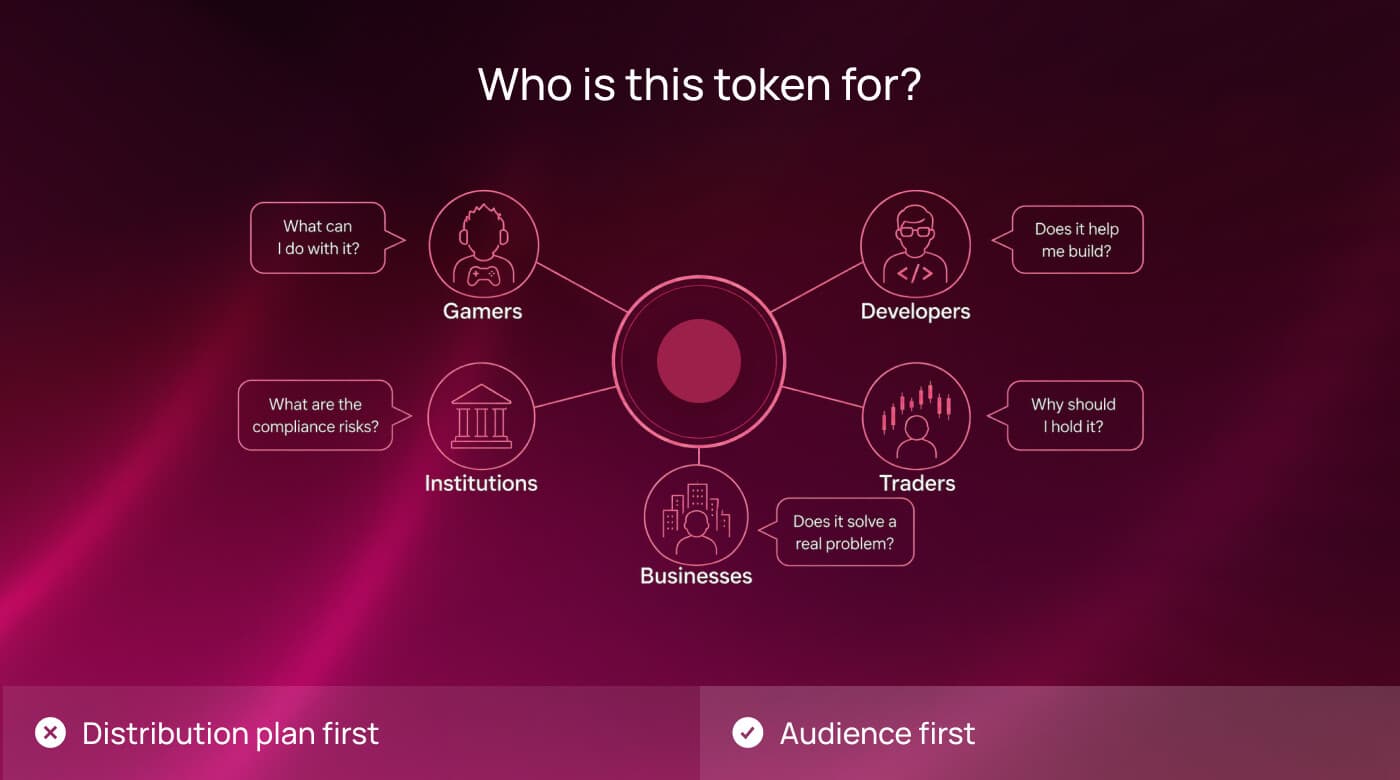
The most common online communities investors hail from are:
- Enthusiasts: take a broad interest and just like to stay informed.
- Gamers: use Play-to-Earn and decentralized gaming experiences. These are usually digital natives.
- Altcoin holders: these people are always looking for outsized potential.
- NFT collectors: these people tend to be art aficionados and those who create it themselves. The focus tends to be on intrinsic value oftentimes.
- Developers: interested in the technical aspects of building blockchain platforms.
Whoever you plan to target is worthy of an in-depth study so that you first can ascertain that they actually exist. Beyond that, you identify where they hang out, what sentiments appeal to them, how to speak their lingo, and what the best platforms and media are to use in promotion.
Selling tokens without tokenomics set in stone first
One of the most structurally damaging mistakes in crypto launches is first going ahead and selling the token via an SAFT (Simple Agreement for Future Tokens) from the get-go, and instead of having the tokenomics fully designed first, they build the economic system afterward to “fit” the sale. This reverses the natural order of product design, since value is the real prize, not temporary growth. That’s going to determine how value is created, captured, and distributed, influencing inflation rates, incentives, vesting, utility mechanisms, and relationships.
Failing to have tokenomics completely crafted from the outset comes from a focus on the short-term rather than the long-term sustainability. What happens is incentives get misaligned between early buyers and the project itself, and pricing becomes speculative rather than functional. So the team is forced to retrofit utility after the fact without any understanding of what drives intrinsic demand. Emission schedules end up being too aggressive or too weak. Utility mechanisms feel artificial.
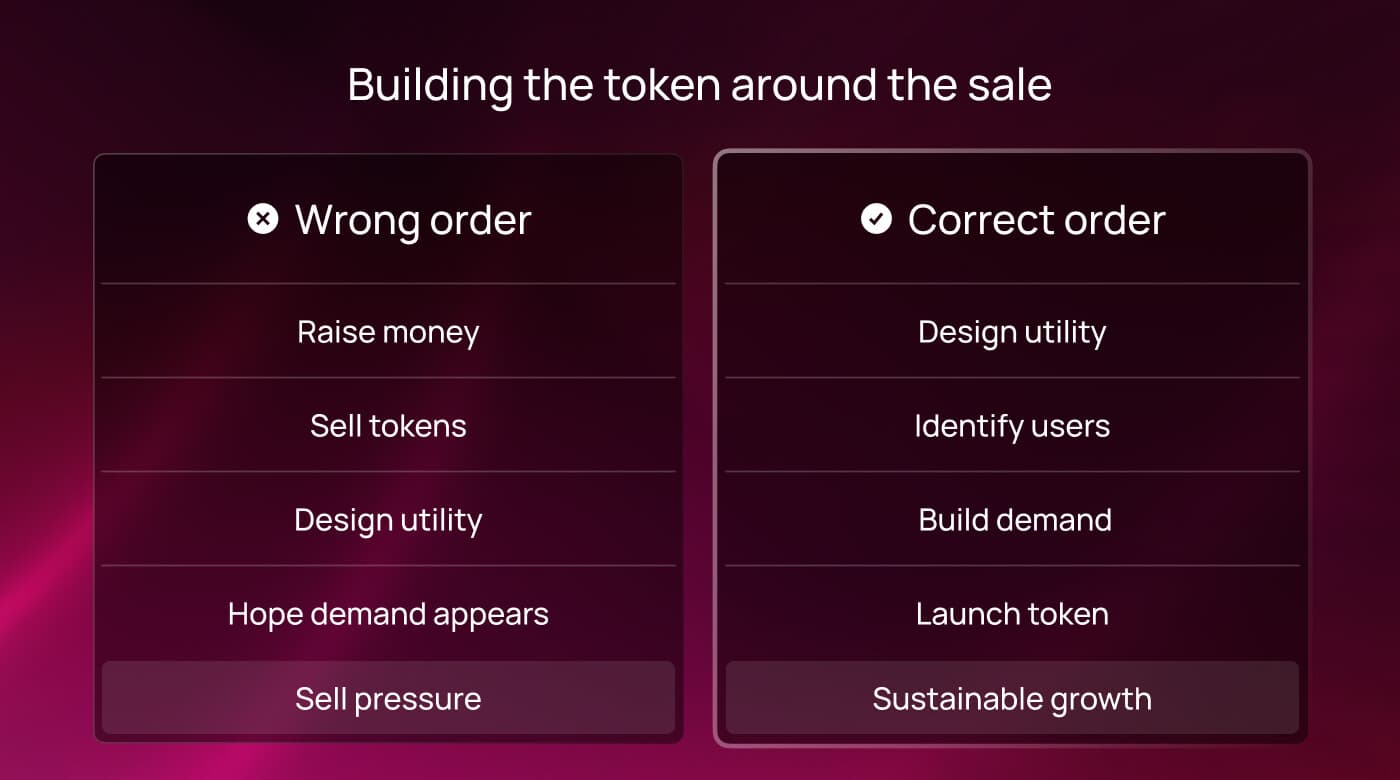
Benefits of pre-set tokenomics
In this case, tokens already have a clear purpose, a defined user base, and a sustainable path to value before the tokens are ever released. This is the only way to ensure that an economic system is in place so that tokens remain an asset rather than devolving into mere financial instruments.
Taking money from the wrong people
Be very careful who you are taking money from, since cryptocurrency has always been quite the haven for corruption, and compliance laws are quite developed now. So there are anti-money laundering and anti-terrorism laws in place. This is because cryptoassets are now seen in practically all types of legal violations.
In crypto, this issue is amplified because capital is publicly visible and highly reflexive. So if a project is caught up with questionable actors, short-term speculators, or groups known for extracting liquidity rather than supporting development, that reverberates quickly through the market.
So starting at the very first ICO, this burning question arises. There are a lot of countries and economic sectors that have been flagged, and thus it’s commonplace for crypto projects to refuse money from those countries. Some countries also have hardline regulations on crypto, for which reason a lot of other investors and funds refuse to put money into a project. Those already invested may be pressured to exit, too. In fact, this can potentially bring about criminal charges for violations or simply regulatory scrutiny.
Once trust is diluted at the funding stage, it’s difficult to recover. Early association with opaque or opportunistic funding sources can permanently cap a project’s credibility ceiling. So disciplined projects treat capital not just as fuel but as an extension of their ecosystem design.
Conclusion
Enthusiasm and genius only go so far without discipline. When it comes to projects in the highly volatile world of crypto, having one’s ducks in a row is key, because one little mistake quickly grows bigger and bigger until it eventually becomes a black hole. The token launch is not the beginning of the process, but the outcome. The preparation itself and the ability to consistently adjust based on that roadmap are where success is seized.
In the now extremely competitive market of crypto projects, there is no room for structural guesswork. It’s not the projects with the strongest narratives that survive, but those with ironclad planning, economics, and execution.
FAQ
Why do so many crypto token projects fail after launch?
They most often stem from early structural mistakes, such as poor planning, unclear economics, unrealistic timelines, and misaligned incentives that only rear their ugly heads after the token is live and the initial hype is over.
Why is budgeting such a critical issue in token launches?
Because real launch costs tend to be far higher than expected. Security audits, compliance, liquidity, infrastructure, functionality, and ongoing operations can quickly exceed initial estimates.
How long does it usually take to launch a crypto token properly?
While some teams expect a few months, a realistic timeline is often 12-18 months when you include every single facet of the project to be accounted for.
What does it mean when a crypto project lacks “unit economics”?
It means the project hasn’t defined its key financial business figures, such as revenue, user acquisition costs, and long-term profitability. Without this, growth often ends up relying only on incentives as opposed to real demand.
Why does token distribution matter so much?
Distribution determines who holds the token and why. If tokens are given to people without genuine long-term interest, they are more likely to sell quickly, creating constant downward pressure.
Why is selling tokens too early a problem?
This can lock in poor incentives and force teams to build utility around a pre-existing financial structure instead of a well-designed economic model.

The Empty Tokens Era Is Over: Why the “Smart Money” Is Rushing to Smart Assets On the Heels of the 2025 Crash
A cascade of liquidations in October 2025 dramatically crashed the Bitcoin from $126,000 to $86,000 and caused millions of empty tokens to vanish from the market. The crypto industry has since entered a phase of real business and awareness – now a token’s worth is directly established as what the business it’s tied to yields in revenue. In this article, we will tell you about projects that managed to make it through the storm and why they are set to shape the future.

Crypto Token Deflation: a Crash-and-Burn Strategy
Deflation is a common practice to bolster a crypto token’s value, which achieves the opposite effect. This short-sighted view restricts opportunities for benefits, acceleration, and problem-solving. Furthermore, tokens behave differently from money and are much less stable. Developers must pursue true utility and functionality before focusing on simpler tactics like scarcity and marketing.

Listing on DEXs: Why Free Exchanges Are the Most Capital-Intensive Story in Web3
The thought of forking over $300,000 to an exchange is pretty daunting. Giving up $300 thousand of your own liquidity in a single day due to an error in the pool is disheartening and scary. In a world of decentralized exchanges, there are no introductory fees, but there is a tax imposed for naivete. And many projects find themselves having to pay it, not upon debuting, but when their schedule turns into a “stairway to hell”. Here is how to avoid falling into that trap and ensure your DEX serves as a springboard, not a financial meat grinder.