EarnPark: weekly vesting removed $1.5m of pre-TGE sell pressure
Audit the token economy before TGE and answer one question: what changes if unlocks happen weekly instead of monthly, with the same amounts, terms and investor conditions?

Audit the token economy before TGE and answer one question: what changes if unlocks happen weekly instead of monthly, with the same amounts, terms and investor conditions?
In the original model tokens unlocked in large monthly tranches. For a young token that creates predictable pressure points: liquidity cannot absorb the volume without a drawdown, the order book is easy to push through, and the market maker cannot smooth the spikes.
- 01
Audited the original tokenomics with monthly unlocks and mapped where supply concentrates
- 02
Re-ran the audit on the updated model with weekly unlocks, giving the client two comparable before-and-after audits
- 03
Modelled the sell pressure on identical inputs: $6m over 12 months means 500,000 per month, or 200,000 sold at a 40% assumption, versus roughly 115,000 a week, or 46,000 sold
Peak potential sell pressure of up to $1.5m was replaced by an even weekly flow that liquidity, the market maker and buyback mechanics can absorb. Investor conditions did not change, and the team walked into TGE with an audited model to show market makers, funds and exchanges.
Hi! Viktorija Kanepe here, the Founder of 8Blocks. We specialize in helping companies make money on blockchain – whether it’s by crafting tokenomics, planning out product mechanics, or making a profit through converting tokens, NFTs, and game models.
This case demonstrates how much a small change in a vesting schedule can radically change a project’s economics.
EarnPark: a British Web3 company
Since 2022, their team has continued developing a digital asset management platform. This is a place where users can publish cryptocurrency, stake shares, and receive earning power via the platform’s investment strategies.
Prior to the TGE, the team decided to also have the token’s economic model evaluated.
But it was important to them to get independent validation and figure out whether the model would withstand the real market, whether it would create excess pressure on the price, and how safe it would be to launch it.
EarnPark’s key question had to do with vesting
In particular, they pondered, “What would happen if instead of unfreezing the tokens once a month, they did it once a week, under the same time periods, volumes, and conditions for investors?
The change seemed inconsequential: after all, the total unlocks volume remained the same as before, the conditions for the investors didn’t change, and they kept the project’s same basic economics.
However, as the analysis showed, the difference turned out to be critical for the market.
Why monthly vesting is dangerous for a fledgling token
In the first version of their tokenomics, EarnPark tokens were unfrozen in a large batch once a month.
This model is straightforward for investors, but it creates a systemic issue after launch. If, in light of these, any of the holders decides to take income, the total volume of supply sellers have can shoot up and weigh down on the token’s price.
Here’s why that’s dangerous for a young token:
- Low liquidity: the market is still incapable of absorbing large volumes without a contraction in the price.
- Unstable trading volumes: it’s easy to push down the order book.
- Market maker challenges: it becomes difficult to smooth out sudden jumps in supply.
In other words, even a well-developed tokenomics appears risky if the tokens are released to the market in overly large portions.
Two tokenomics scenarios and one handy conclusion
We conducted an audit of EarnPark’s tokenomics and modeled two different scenarios separately :
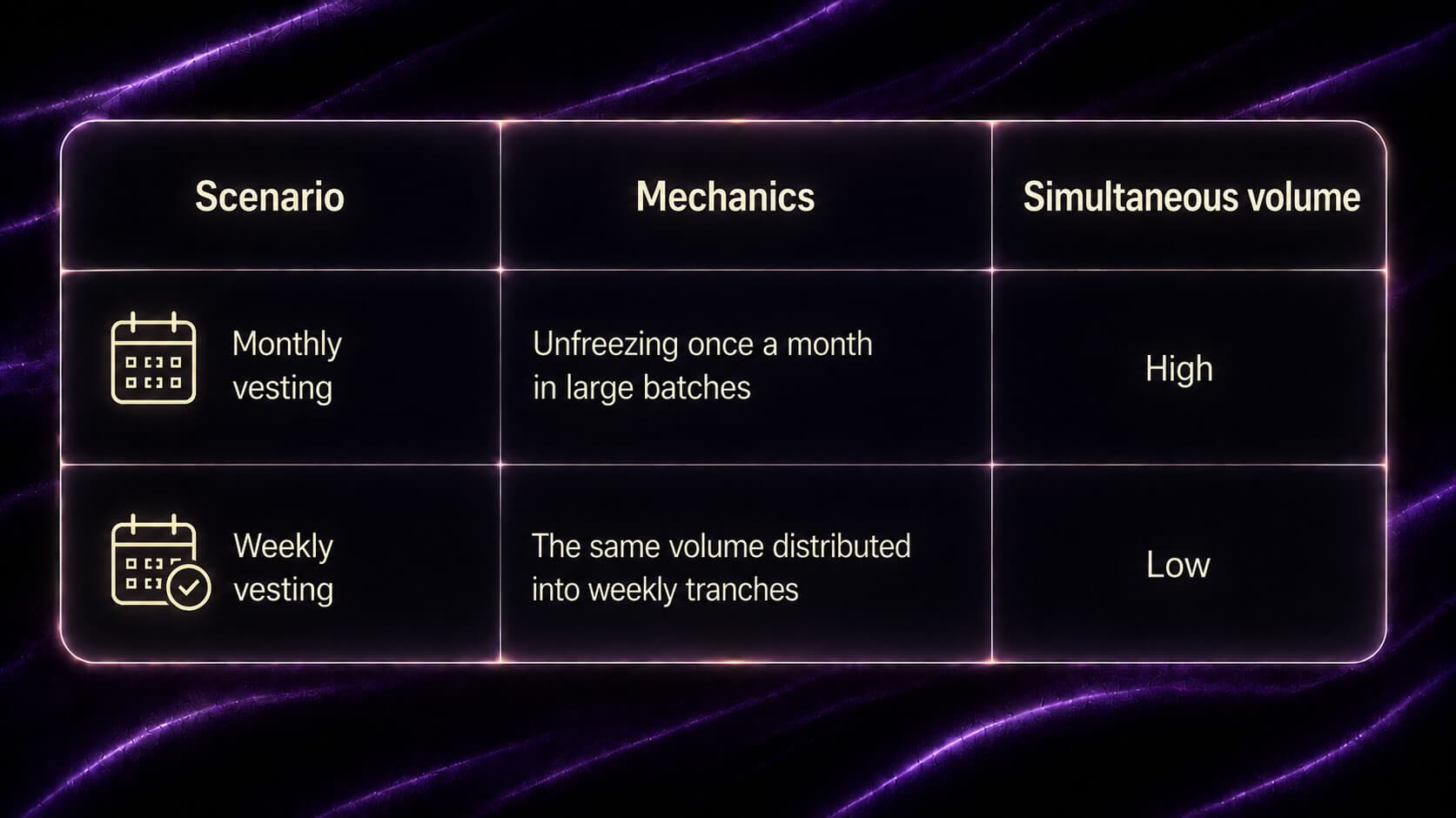
An important thing to note here is that in the second scenario, the investors’ conditions didn’t change. They get exactly the same number of tokens, have to wait just as long, and don’t lose any benefit.
The only thing that changes is the rhythm in which the tokens hit the market. That’s the specific factor that played the main role in relieving the market pressure.
A deeper dive into our conclusions
First, we analyzed the old version of their tokenomics. Then, the EarnPark team provided us an updated model with weekly unlocks, and we then reassembled the audit on that basis.
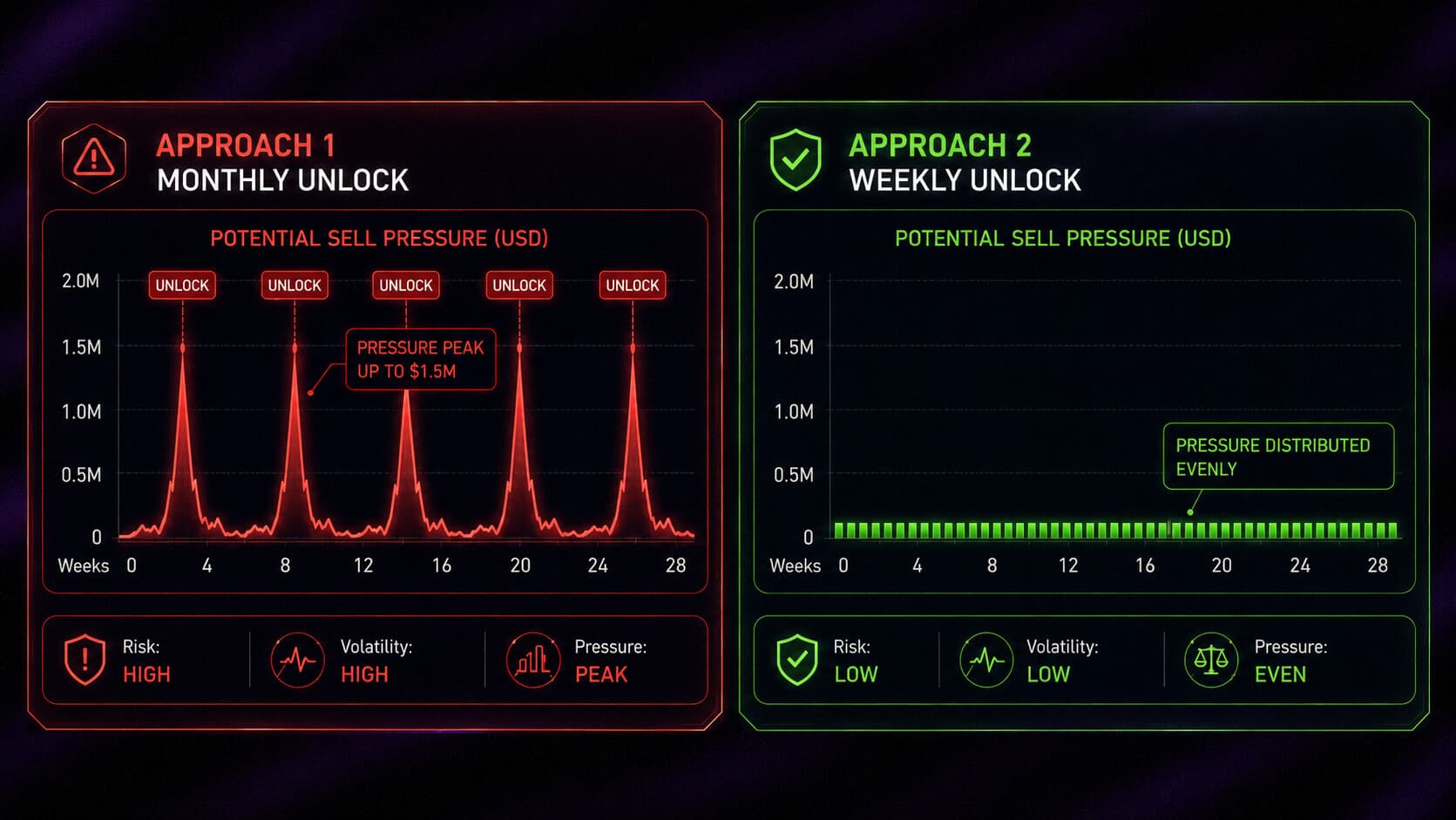
The client ended up with two comparable audits – a “before and after”. This allowed us to demonstrate the difference using hard numbers.
- Under monthly vesting: during certain periods, a peak potential sales pressure arose of up to $1.5 million.
- Under weekly vesting: the pressure relaxed and spread out smoothly over time.
What the market got instead of one major event was a multitude of small events, which liquidity, the market maker, and buyback mechanisms are capable of painlessly digesting.
Calculations example
Let’s model the same unlock volume for the two scenarios.
Hypothetical exercise:
- Total unfreezing volume: $6 million
- Vesting period: 12 months
- Allocations and time periods: same
- Investor conditions: same
- All that’s changed is the unlock frequency
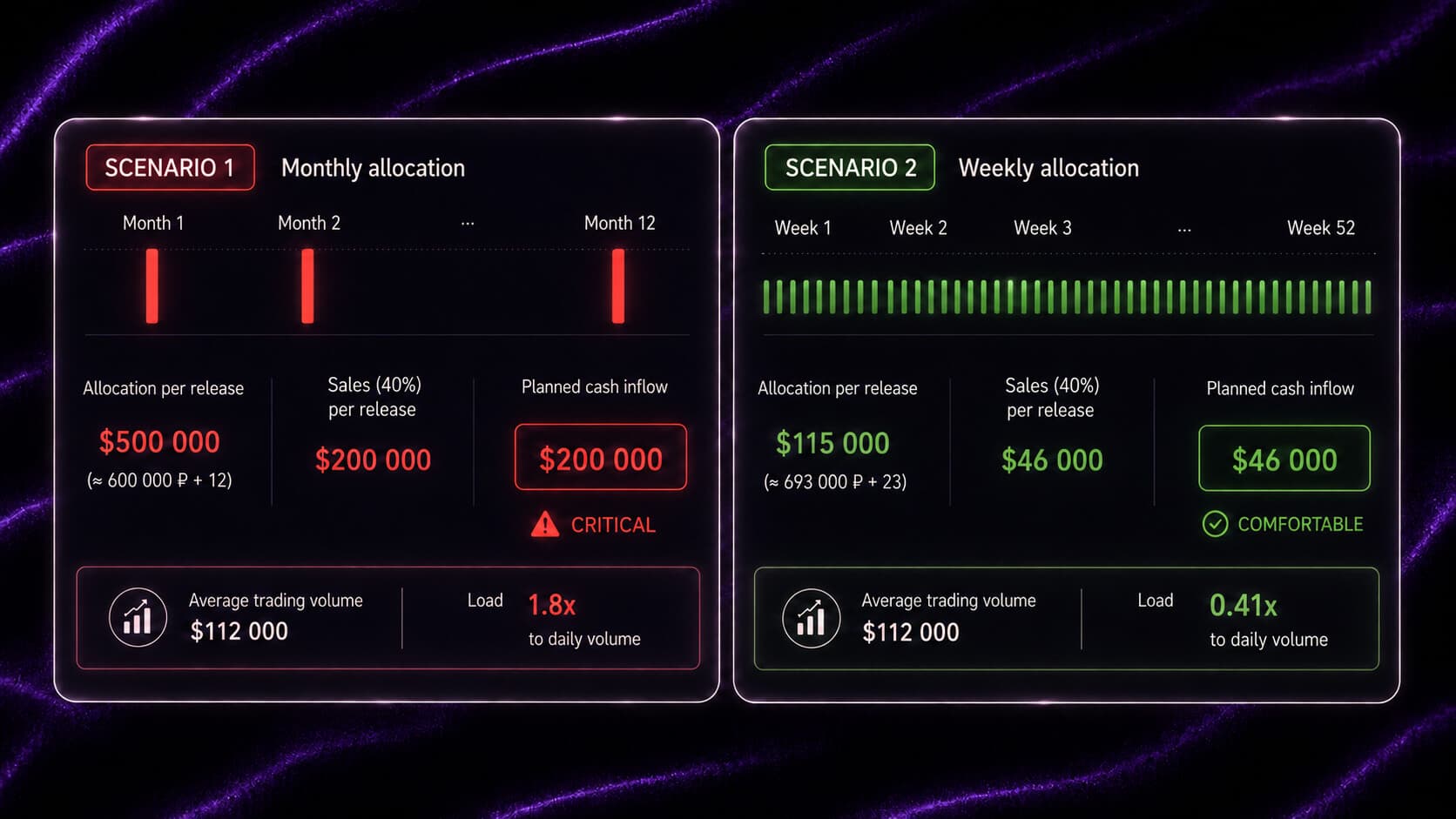
In the first scenario, tokens hit the market just once every 30 days. In other words, each unlock is: 6,000,000 ÷ 12 = 500,000 per month.
Meanwhile, suppose that right after the unfreeze, the investors sell 40% of the tokens they got (a typical conservative scenario for pressure calculation). In that case, the potential sales volume all at once would be:
500,000 × 0.4 = 200,000
In other words, within a short time interval, the market can get shaken with an additional $200,000 in supply. For a token with a $112,000 daily trading volume, that’s a critical load.
Now let’s check out the second scenario, where instead of being split up into 12 months, that same 6 million is broken down into 52 weeks. There turns out to be 115,000 daily unlocks. Under the same presumed 40% of unfrozen volume sold, the weekly pressure reaches 115,000 × 0.4 ≈ 46,000. Instead of 200,000 at once, around 46,000 hit the market.
The difference in the peak load is more than fourfold – once again, without any detriment to the conditions investors get.
In tokenomics, people are used to checking out percentages of allocation, but…
What the market also cares about is the flow of tokens over time. The same volume can behave fundamentally differently, just depending on the unfreezing frequency.
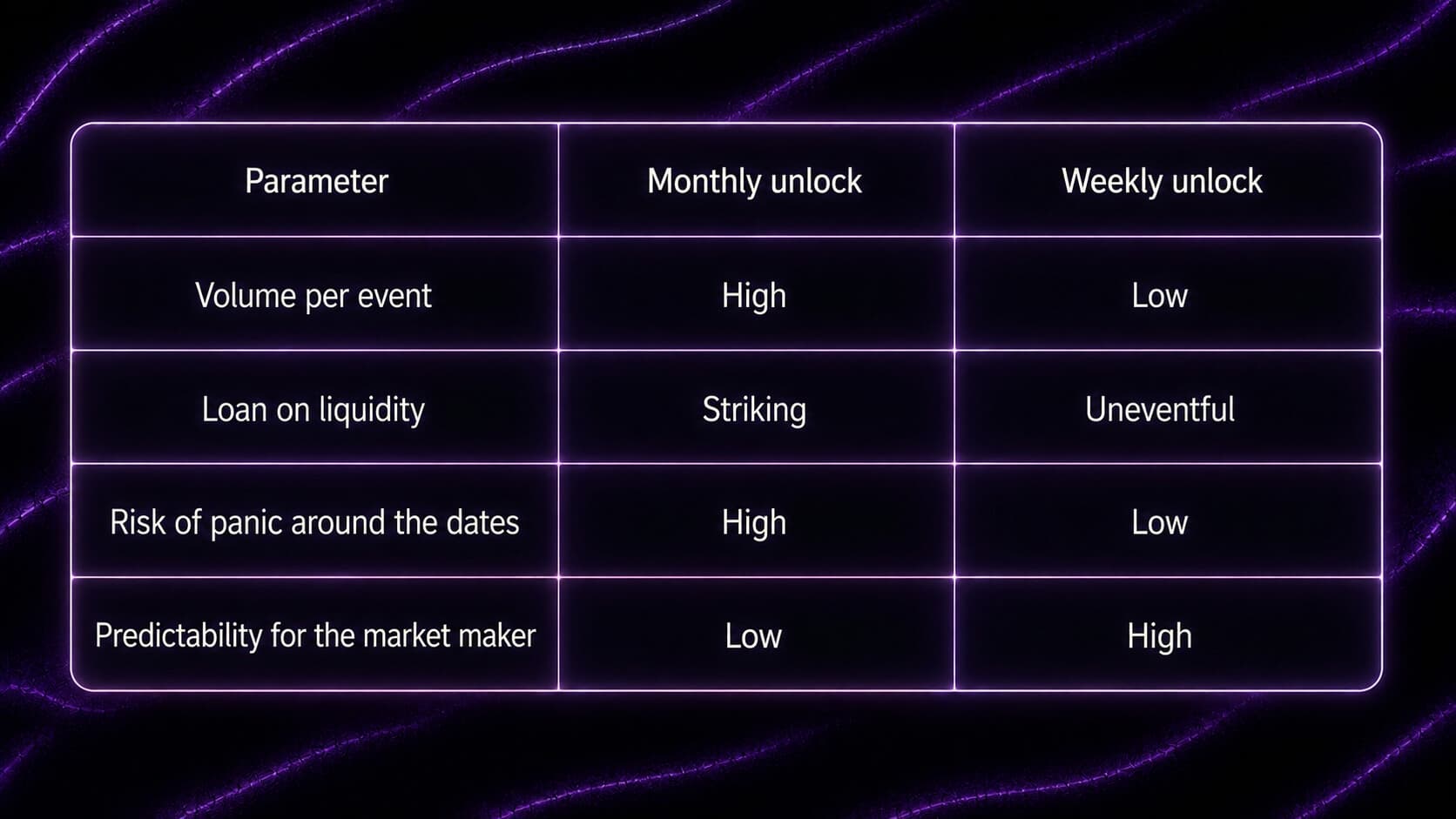
Monthly unlocks create predictable pressure points: every such day provokes panic and throws off the market maker. Weekly unlocks spread out the load and render it uneventful. For instance, with a daily circulation of 100,000 and 40,000 unfrozen, the market will digest the volume without any consequences. The panic disappears as well, since unfreezing becomes routine and investors actually forget about the dates.
In practice, this gives the project three things: the price doesn’t undergo abrupt contractions, the community doesn’t live in fear unlock to unlock, and the market maker can handle supply effectively without requiring massive reserves.
Smooth effect: less uncertainty leading up to the token launch
This is especially important for projects planning on their token sticking around for a long time, as opposed to a short-term pump around the TGE.
Any excess volatility during the first months not only affects the price, but trust in it as well: how early investors perceive the token, how calmly new holders get involved, and how quickly the project’s reputation is built on the market.
Essentially, before ever launching, EarnPark managed to test how its economics would behave under real pressure conditions without taking lessons the hard way through expensive errors after having already listed.
Furthermore, the team got a hold of stronger materials for negotiation with partners: market makers, funds, and potential listing platforms. Because, rather than having some abstract “good tokenomics,” they gained a model, a confirmed audit, and a comparative analysis.
Come get your tokenomics
Good tokenomics shouldn’t merely distribute tokens but also help a project endure the first months of trading without having to suffer excess volatility, panic, and lost trust.
Sometimes doing so doesn’t require reassembling the entire tokenomics. Rather, it requires you to find a weakness just in the nick of time and fix the mechanics before the market does it for you.
We are just the people to help you with that. Feel free to apply here.