Is Your Token Ready? The Complete Tokenomics Audit Checklist
Review every critical component of your token economy with this complete tokenomics checklist, from supply and incentives to governance and market readiness. Don’t launch a TGE, raise capital, or rework tokenomics until thoroughly covering your bases.
A tokenomics audit checklist is a structured framework for reviewing the core components of a token economy before a launch or major redesign. It evaluates a project’s supply model, distribution, utility, incentives, governance, and whether other economic mechanisms are logically designed, internally consistent, and sustainable in the long term.
When it comes to handling tokenomics, tokens matter for far more than just representing value. They drive participants’ behavior, the functioning of protocols, and the compromises reached to keep every stakeholder happy. Meanwhile, aspects like governance, treasury, supply, utility, and distribution are so fickle that they must be well-vetted in advance to ensure that the behaviors and events that will indeed follow on the open market are those that the project developers intended.
Once a token hits the open market, it's largely a point of no return, and the recipe for actually successful tokenomics is always different. The potential bottlenecks are so numerous – speculators just buying early to sell the token off later with no intent to hold onto it, supply getting released too quickly, mismatched interest among the stakeholders, value existing but not being rigidly preserved within the token, trust vanishing on the heels of discrepancies with the white paper, and so many more.
In the spirit of preparation and covering the bases in tokenomics, presented below is the complete tokenomics audit checklist to help ensure that a project is ready for the myriad of possible contingencies.
Supply & emissions
This here refers to the total token supply, the rate at which tokens enter the market, and the mechanisms balancing creation with removal for economic stability. The area governs how a project manages token scarcity and distribution over time.
Is the maximum token supply clearly defined?
To see if the ecosystem can support the growth, it’s an absolute must that the ongoing expansion of the supply is deliberate and transparent, without any terms existing in the white paper that could possibly be misinterpreted. Part of that is the supply must be fixed, deflationary, or inflationary to assure stakeholders of how many tokens can ultimately exist and what exactly they’ll get spent on.
- Is an unalterable maximum supply cap hardcoded directly into the genesis smart contracts?
- Are there any ambiguous clauses in the white paper or code that allow for arbitrary or unscheduled minting?
- Does the chosen supply model directly match the project’s underlying business logic?
- Is the terminal token count easily discoverable and transparent for all stakeholders?
Is the emission schedule sustainable?
Emissions need to be distributed in a way that supports ecosystem growth while curtailing unnecessary selling pressure. Projects need to model supply changes over months and years, not merely on the launch.
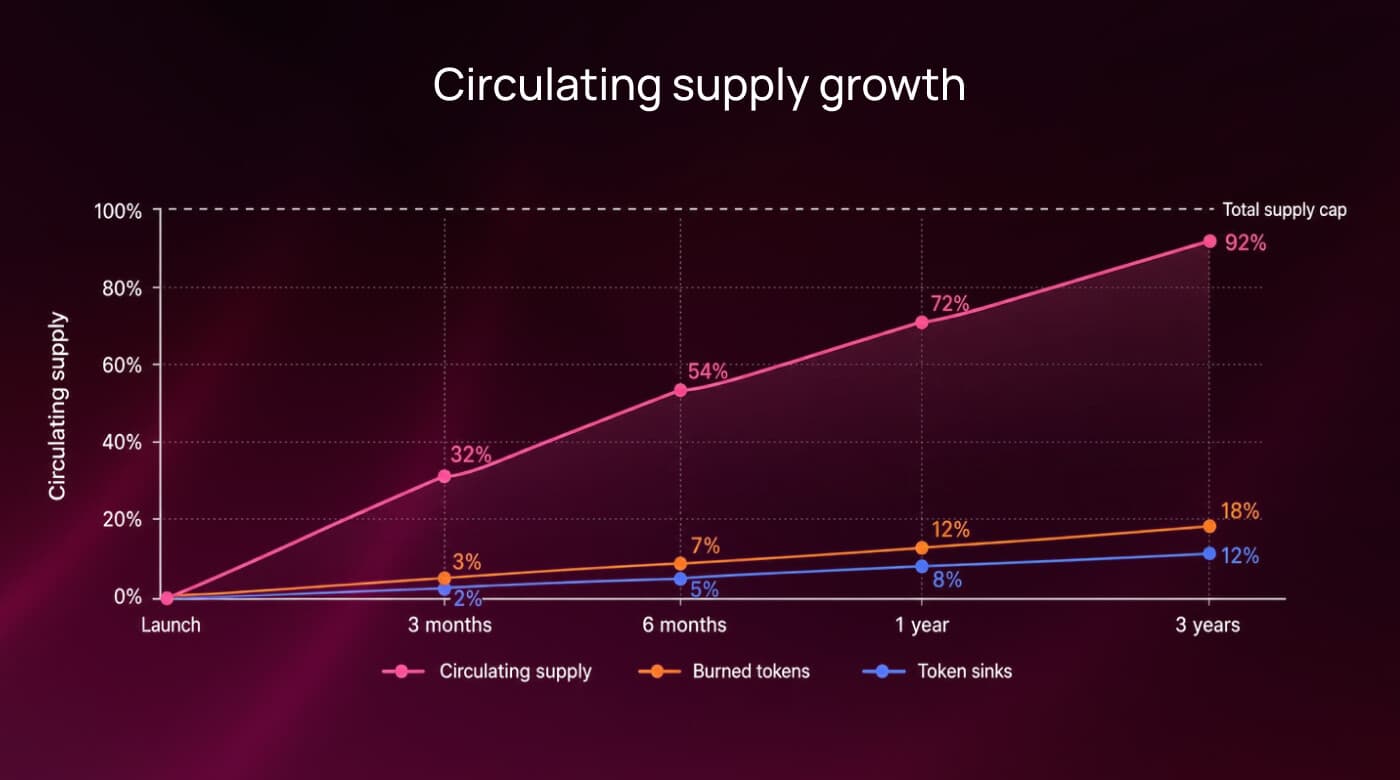
- What exact percentage of the total supply will be in active circulation at the 3-, 6-, 12-, and 36-month milestones?
- Is the release velocity mathematically fixed or algorithmically tied to verifiable network growth metrics?
- Can the organic market demand absorb the projected daily and weekly emission volumes without the price tumbling?
- How will the ecosystem sustain user retention once the initial high-yield bootstrapping incentives taper off?
Are existing inflation and token sinks properly balanced?
Inflation is not inherently bad. This, after all, is how validators, users, and ecosystem contributors get rewarded. The question, though, is whether demand and token sinks can absorb newly created supply. Token sinks remove tokens from active circulation or encourage long-term holding.
- Can the planned token sinks realistically absorb the velocity of new token creation?
- Do the burning mechanisms permanently remove tokens from the total supply, or do they just store them in a treasury?
- Does the staking infrastructure offer real yield generated by protocol fees, or does it just rely rather on printing more tokens?
- Are protocol fees, governance rights, and product payments deeply integrated to require the native token?
Allocation & distribution
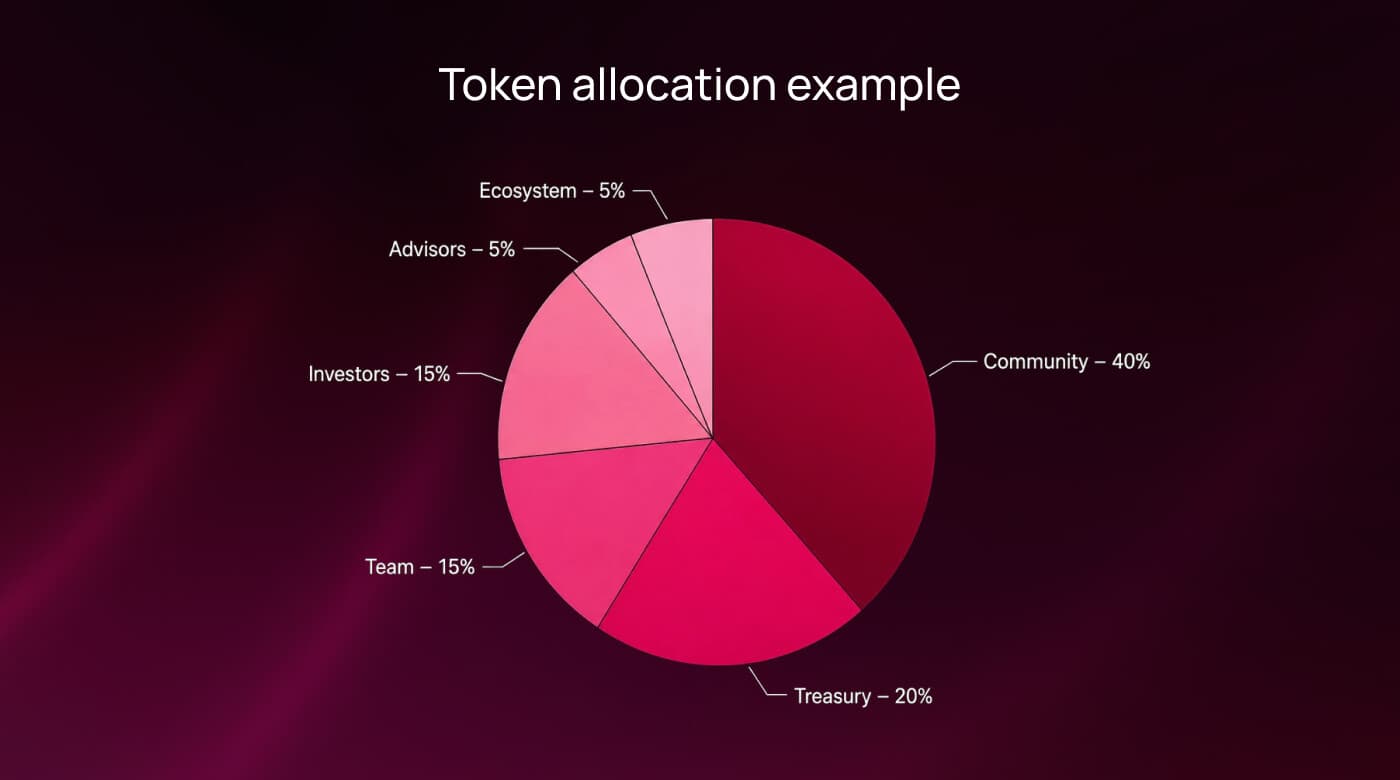
Allocation entails who owns the supply at launch, how ownership will shift over time, and evaluating how much clustering there is among a few wallets. It’s essential, meanwhile, in all of this to make sure that locked allocations are truly locked via vesting contracts and timelocks. These break down into private rounds, advisors, team allocations, and disclosures.
Is the token allocation balanced across stakeholder groups?
Having too large a share of the tokens among a small group of holders can throw off stability. Such persons would wield an outsized influence on the price of the token. Thus, if suddenly they decided to sell them off all of a sudden, everyone else may follow suit, causing a drastic collapse.
- Does the distribution strategy prevent any single stakeholder group from wielding outsized influence over the token price?
- Are the individual allocation splits between the core team, private investors, and public community transparently disclosed?
- Can the market absorb potential sell-offs from a single group without triggering a cascading panic among other holders?
Is there a risk of over-concentration among insiders?
If the insiders hold a ton of the tokens, that could damage trust and confidence, which has been the case, for instance, in YZY tokens, when insiders held 94% of the token, leading to its crash.
- Is the cumulative insider share low enough to maintain public trust and market confidence?
- Are all large token holders bound by strict, reasonable vesting schedules and lockup periods to prevent sudden dumping?
- Does the allocation model avoid catastrophic vulnerabilities?
Does the distribution support long-term ecosystem development?
There also have to be proportionately allotted tokens for planned growth programs that cannot be prematurely exhausted.
- Are proportional allocations explicitly locked away and reserved for ecosystem funds, grants, partnerships, community incentives, and liquidity pools?
- Is the project treasury capitalized well enough to cover multiple years of continuous development and operational runway?
- Can community rewards and liquidity pool incentives scale dynamically without destabilizing the overall ownership structure?
Test your numbers in real time
Projects curious about how their initial emission targets will impact their market cap over the next 12 months need not leave the foundational math to guesswork. Take advantage of the free tokenomics calculator to model inflation and distribution by entering the supply cap and vesting timelines to visualize how circulating supply will scale.
Vesting & unlock schedule
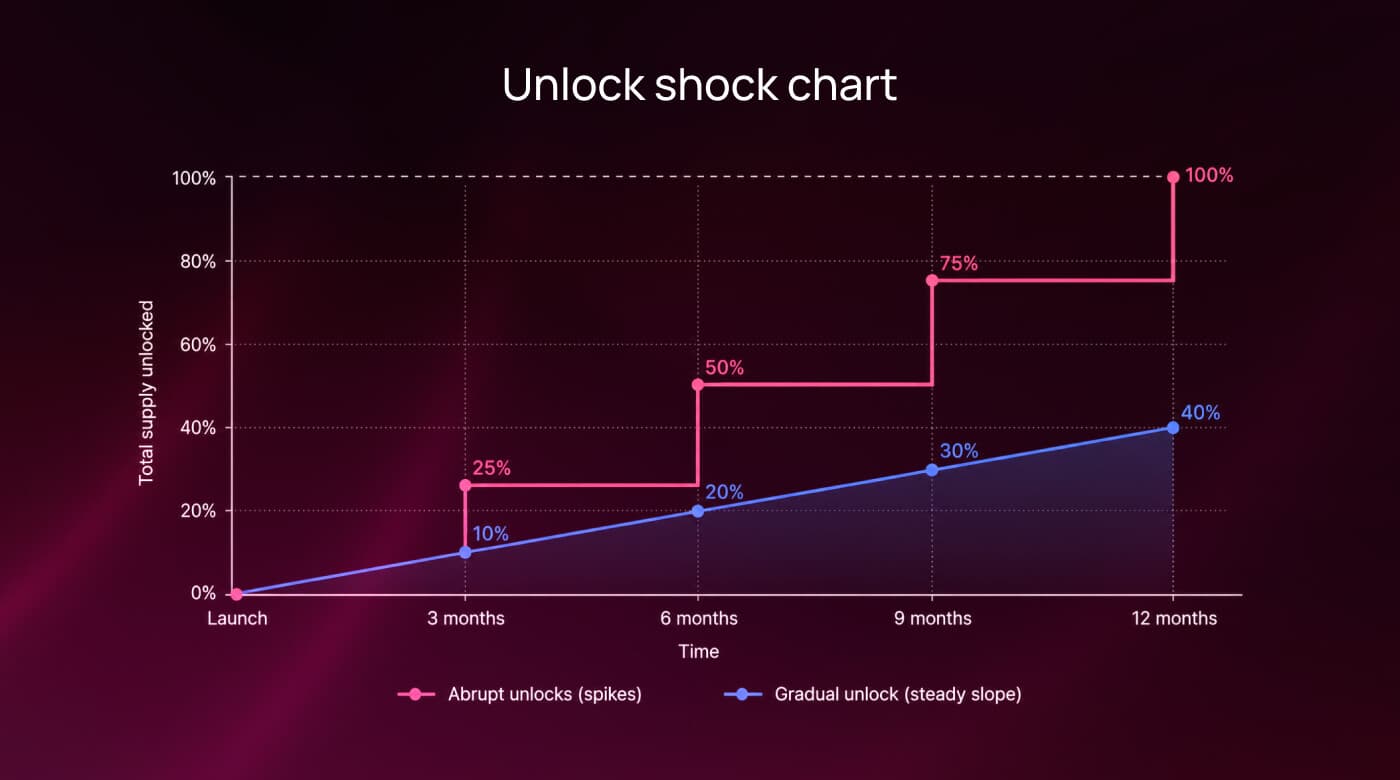
This is what defines when allocated tokens become available for circulation and how supply is released over time. It’s one of the most critical stability mechanisms in a token economy as it directly controls sell pressure from early stakeholders.
Are vesting schedules designed appropriately for each stakeholder group?
The way and period through which creators align incentives investors perceive as a sign of founders’ commitment and transparency. The team holding onto 20% of supply is excessive, while many consider a share of above 10% to be a lot.
- Is the team holding over 10% to 20% of the total supply without extended lockups?
- Do the vesting timelines span multiple years to demonstrate the founders’ long-term commitment and transparency to investors?
- Are vesting structures customized based on each stakeholder’s specific role, funding round, and risk exposure?
Do unlock events create excessive selling pressure?
Even if the timing of unlocks is well-defined, it will introduce risk. Large, concentrated unlock events often lead to sudden flooding of supply, which might outweigh the rise in market demand. Another important thing is that these releases aren’t too clustered at one particular moment and that they don’t surpass anticipated liquidity.
- Are token unlock dates structured to avoid large, concentrated events that overwhelm organic market demand?
- Does the model limit early insider sales to under 5% of the supply to prevent immediate, heavy selling pressure on the horizon?
- Does the projected unlock volume closely match the token’s anticipated market liquidity and depth?
Are the cliff and linear vesting mechanisms balanced effectively?
These serve different purposes. The former delays initial access to tokens while the latter distributes tokens gradually over time. A balanced model uses both, depending on the type of stakeholders and the ecosystem's maturity.
- Does the project utilize cliffs to delay initial token access until stakeholders have delivered verifiable value?
- Is linear vesting used after the cliff to distribute tokens gradually over time instead of all at once?
- Have the potential market shocks of these combined mechanisms been thoroughly stress-tested against aggressive trading scenarios?
Token utility & demand
These determine whether a token has a functional role inside its ecosystem or exists primarily as a speculative asset. A strong token model creates consistent demand tied to real product usage rather than short-term incentives.
Does the token have real in-product utility?
A token should be required for meaningful interactions inside the ecosystem, not just held for speculative purposes. Utility can come from payment, access, governance, or network participation, but it must be integrated into the core product flows as opposed to being added as an afterthought.
- Is the token required to use key product features?
- Does it play a role in transactions or protocol usage?
- Is governance participation meaningfully tied to the token?
Is there demand beyond speculation?
Speculative demand can drive early activity, but it is not sufficient for long-term stability. Sustainable demand comes from users who need the token to access services, participate in the network, and benefit from ongoing ecosystem activity.
- Is the demand driven by actual product usage?
- Are there clear, non-speculative reasons to acquire the token?
- Does demand persist during quiet times on the market?
- Is token usage embedded into regular user behavior?
Does demand survive after incentive programs end?
Many token economies rely heavily on rewards to bootstrap activity, but these incentives are often temporary. A key test of token design is whether users continue to engage with the system once emissions or reward programs quiet down.
- Would users still interact with the system if the rewards vanished?
- Are the incentives truly supplementing real utility as opposed to replacing it?
- Has demand been modeled under reduced incentive scenarios?
Incentive & reward design
This is how the different roles of people are encouraged and directed in a given ecosystem. That means how they earn tokens, what specific actions are being rewarded, and whether those rewards will be sustainable. Especially key is that what’s being incentivized sticks around long-term once the new capital stops flowing in.
Are rewards funded in a sustainable way?
It’s crucial that they’re backed by a clear economic source like protocol revenue, emission schedules, and treasury allocations with a finite runway. Otherwise, inflation can get out of hand if left unbalanced.
- Are the sources of the rewards clearly defined?
- Is there a maximum or declining reward schedule?
- Has reward sustainability been modeled over time?
- Are rewards aligned with real ecosystem value that’s being created?
Do incentives create a reliance on new participants?
If so, this breeds structural fragility where the system only functions while growth continues.
- Do rewards require continuous new users to remain viable?
- Is there a dependency on token price appreciation to fund incentives?
- Can the system operate if growth flattens or declines?
- Are rewards tied to long-term participation rather than short-term activity?
Do incentives reinforce long-term alignment?
Effective incentive design encourages behaviors that strengthen the ecosystem as time goes on, such as long-term holding, productive usage, or governance participation. Short-term farming and extractive behaviors must not be allowed to be more than a sideline phenomenon.
- Do rewards encourage long-term participation?
- Are there mechanisms discouraging short-term exploitation?
- Is there alignment between user rewards and protocol value creation?
- Has incentive behavior been tested under different market conditions?
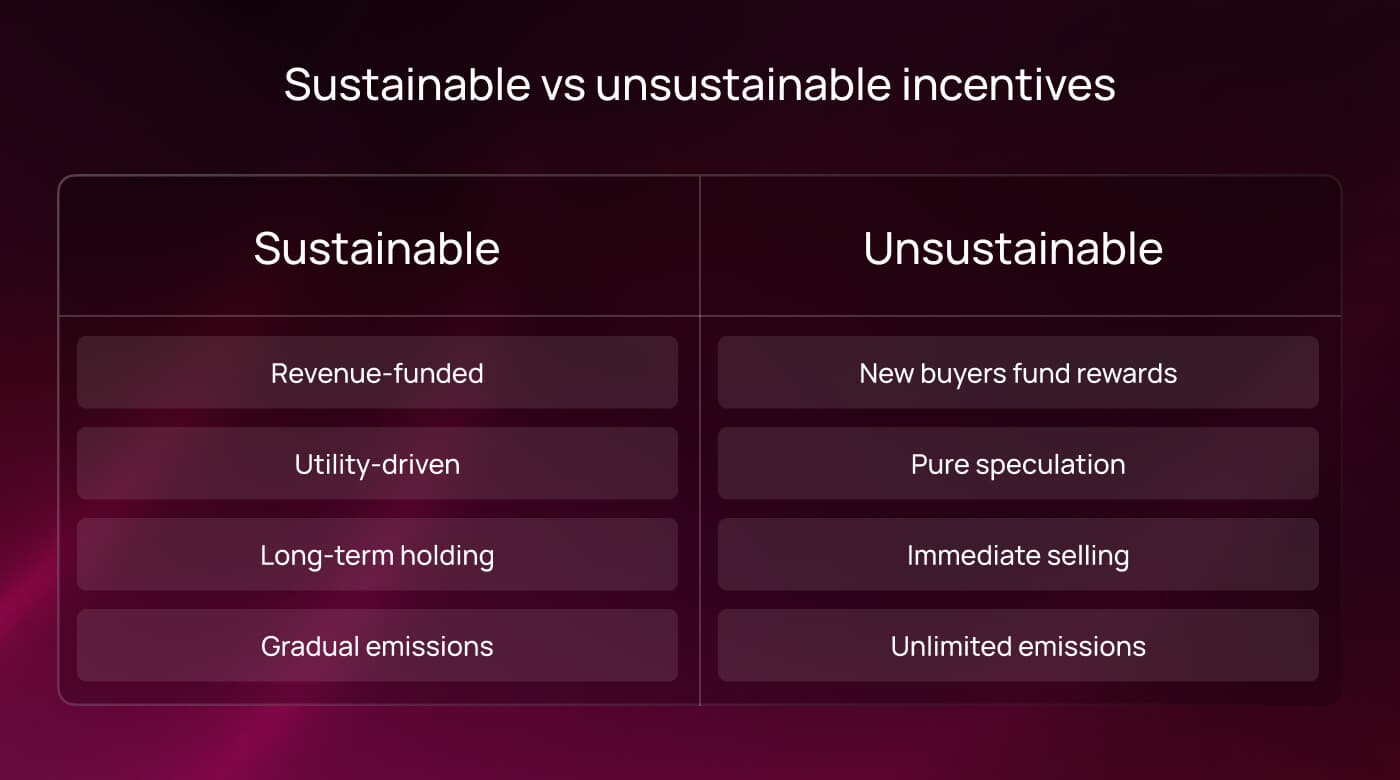
The line between an innovative reward mechanism and an unsustainable loop is incredibly thin. If your token relies entirely on continuous user acquisition to survive or doesn’t have a precise plan for how incentives will give way to long-term value, the model will eventually break down under market pressure.
Tokenomics audit checklists are only scratching the surface, and only a full-blown audit can provide legitimate clarity to handle tokenomics responsibly. If you want to verify that your management handles your emissions at the least possible risk, 8Blocks tokenomics auditing can help. Request a tokenomics audit today to gain a confident direction for your project.
Governance & treasury
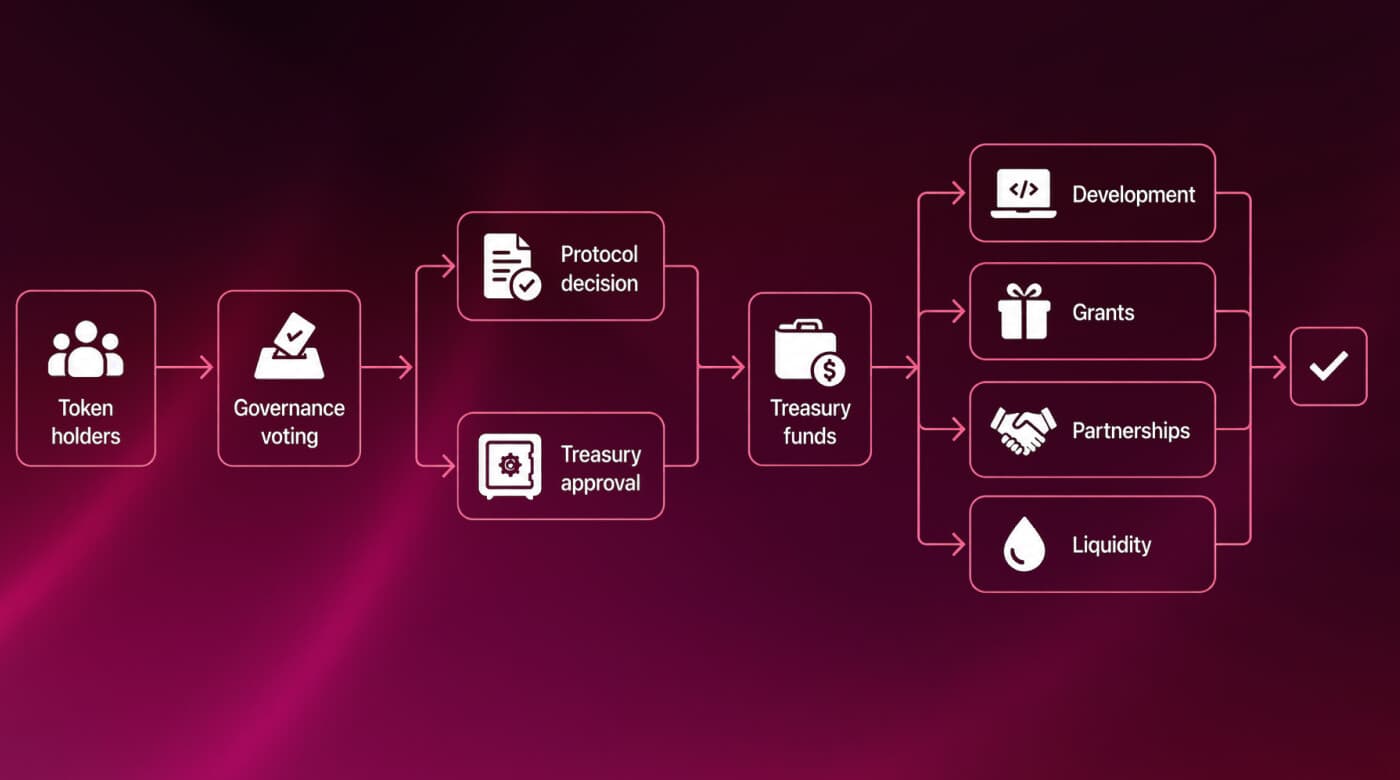
Governance and treasury determine how decisions in a token economy are made and how resources are managed over a long period of time. The former decides who has influence over protocol changes, while the latter controls how the product funds development, incentives, and growth. Both must be robust and crystal clear for coordination to execute well and the project to be sustainable.
Are governance rights clearly defined and meaningfully structured?
It has to be defined who can propose changes, who can vote, and how voting power is distributed. A well-structured governance avoids both excessive centralization and ineffective decentralization while still reflecting stakeholder alignment.
- Are governance rights clearly documented in the protocol design?
- Is voting power distributed in a way that avoids extreme concentration?
- Are decision-making processes transparent and accessible?
- Can governance evolve as the ecosystem matures?
Is the treasury structured for long-term sustainability?
This acts as the financial backbone of the ecosystem, providing for development, grants, partnerships, and operations. Allocation strategy and duration have to be defined in as straightforward a fashion as possible.
- Are the treasury size and purpose clearly defined?
- Are funds allocated across short-term and long-term needs?
- Is there a transparency strategy for treasury usage over time?
- Has treasury depletion risk been modeled?
Are liquidity provisions sufficient for stable market operation?
Without liquidity, trading can absolutely wreck the value of a token, and everyone else can follow suit in a sell-off. The price may fluctuate all over, even if the tokenomics are rock-solid otherwise.
- Are liquidity pools or market-making strategies defined at launch?
- Is initial liquidity sufficient for expected trading activity?
- Are liquidity incentives sustainable over time?
- Has liquidity depth been modeled under different market conditions?
Legal & classification readiness
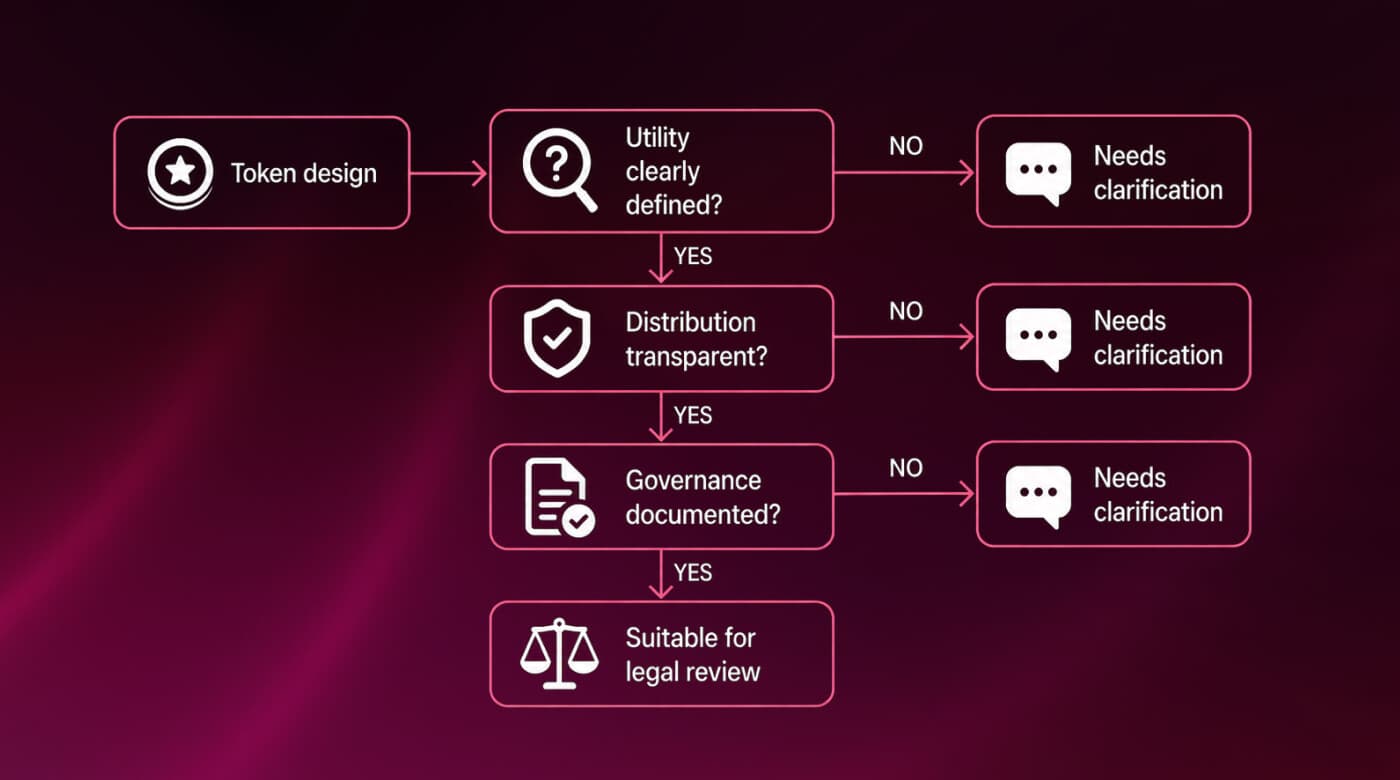
These terms refer to how clearly a token’s structure, purpose and distribution model will be looked at by regulators. Tokenomics audits can surface structural risks that may create ambiguity during a legal review. A project needs sufficient clarity to avoid misinterpretation of its mechanics or documentation.
Is the token structure clearly defined in the documentation?
The token’s purpose, functionality, and role in the ecosystem call for very concrete outlined designation. That includes how it’s used, how it’s distributed, and what rights, if any, it confers to holders.
- Is the token’s purpose clearly defined in the white paper?
- Are the utility functions explicitly described?
- Is the distribution model transparent and documented?
- Are all token rights and limitations clearly stated?
Could the token be misinterpreted as a financial instrument?
Certain design choices like profit-linked mechanics, revenue-sharing, or investment-like framing can cloud the appropriate classification. Even pure utility tokens can cause issues.
- Does the token avoid explicit profit-sharing mechanisms?
- Is the language focused on utility rather than investment return?
- Are incentives structured around usage rather than yield expectations?
- Has the design been reviewed for classification risk signals?
Is the project prepared for external legal review?
External legal counsel needs to be able to evaluate it without requiring major redesigns of the economic system.
- Is all token-related documentation consistent across sources?
- Can the token model be explained without contradictions?
- Are governance and utility functions clearly separated from financial expectations?
- Is the system structured in a way that renders legal due diligence feasible?
Launch & market readiness
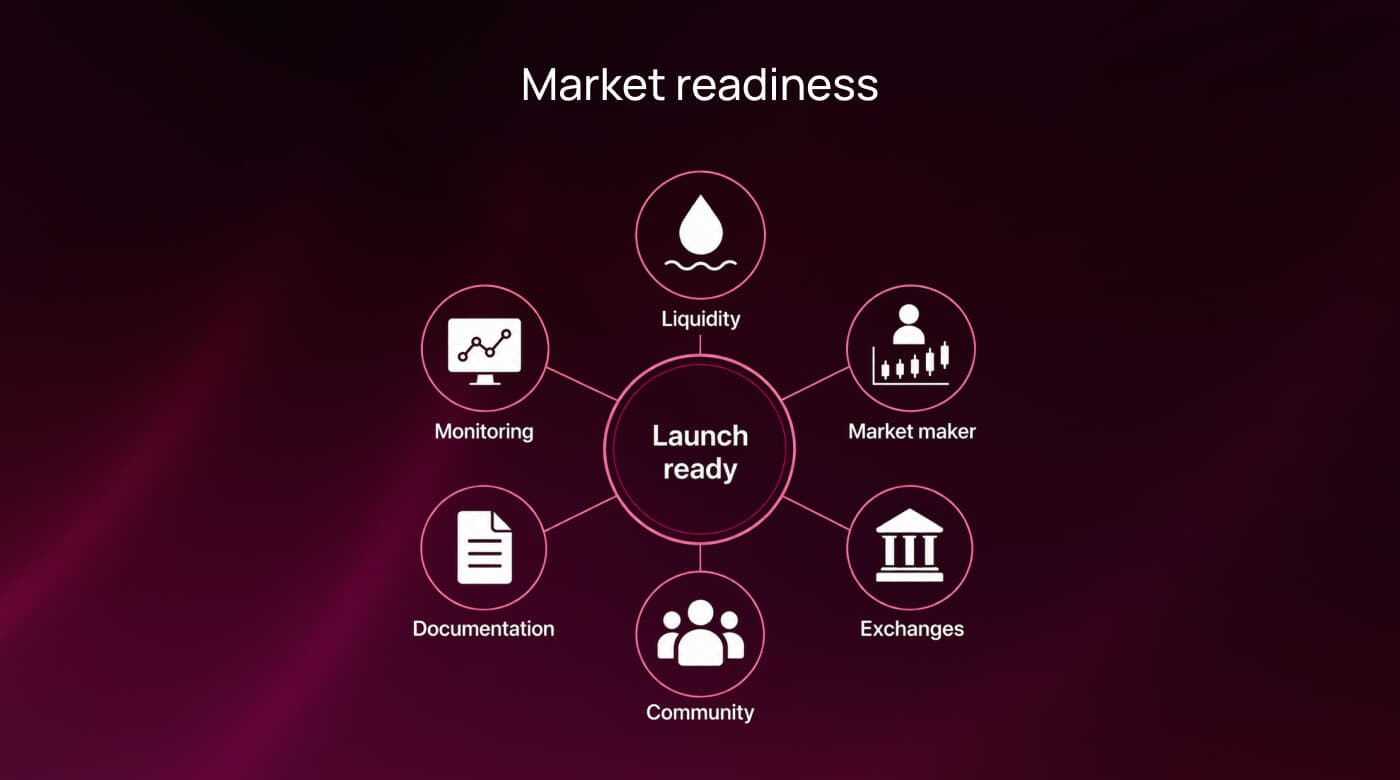
This evaluates whether a token economy is prepared for the open market once it goes public. Even if tokenomics look spic and span on paper, a lot of things can still be glossed over that lead to unstable price discovery and rocky early market formation. These may be liquidity, trading depth, less-than-ideal exchange environments, and so on.
Is there a clear market-making and liquidity strategy?
A token needs structured liquidity before it’s launched so it can be traded without massive, nerve-wracking volatility. Market-making strategies create the conditions for fair price discovery, so that a chain reaction of selling off the token doesn’t occur.
- Is there a defined market-making strategy for launch?
- Are liquidity pools or provisioning plans established in advance?
- Is initial liquidity sufficient for expected trading volume?
- Are liquidity incentives planned beyond the launch phase?
Is the token prepared for exchange or listing requirements?
Different exchanges and trading venues have specific listing requirements in terms of liquidity, documentation, compliance, and technical integration. Preparing these in advance reduces friction and smoother market entry.
- Is the token compatible with the target exchange’s standards?
- Are technical integration requirements clearly understood?
- Have compliance and disclosure been reviewed for listing eligibility?
Does early market structure support stable price discovery?
Early trading conditions heavily influence the way the market is perceived in the long run. If liquidity is too thin or unevenly distributed, price discovery might not reflect the underlying fundamentals. Distortion should be reduced during the first phases of trading.
- Is liquidity distributed across the relevant trading venues?
- Are early buyers and sellers likely to enjoy balanced conditions?
- Has initial volatility risk been modeled?
- Are mechanisms in place to prevent extreme price swings at launch?
Measures for stability
You can have the perfect market-maker, guaranteed exchange listing, and deep liquidity pools, but if your core tokenomics are broken, your launch will still be doomed to fail. Market readiness requires more than just marketing. It calls for extensive preparedness and high-level precision. Before you push your token architecture to production, covering your bases for your model is a must.
Request a tokenomics audit from 8Blocks today to stress-test your supply, distributions, and incentives against aggressive market conditions to launch your project with confidence.
Key Takeaways
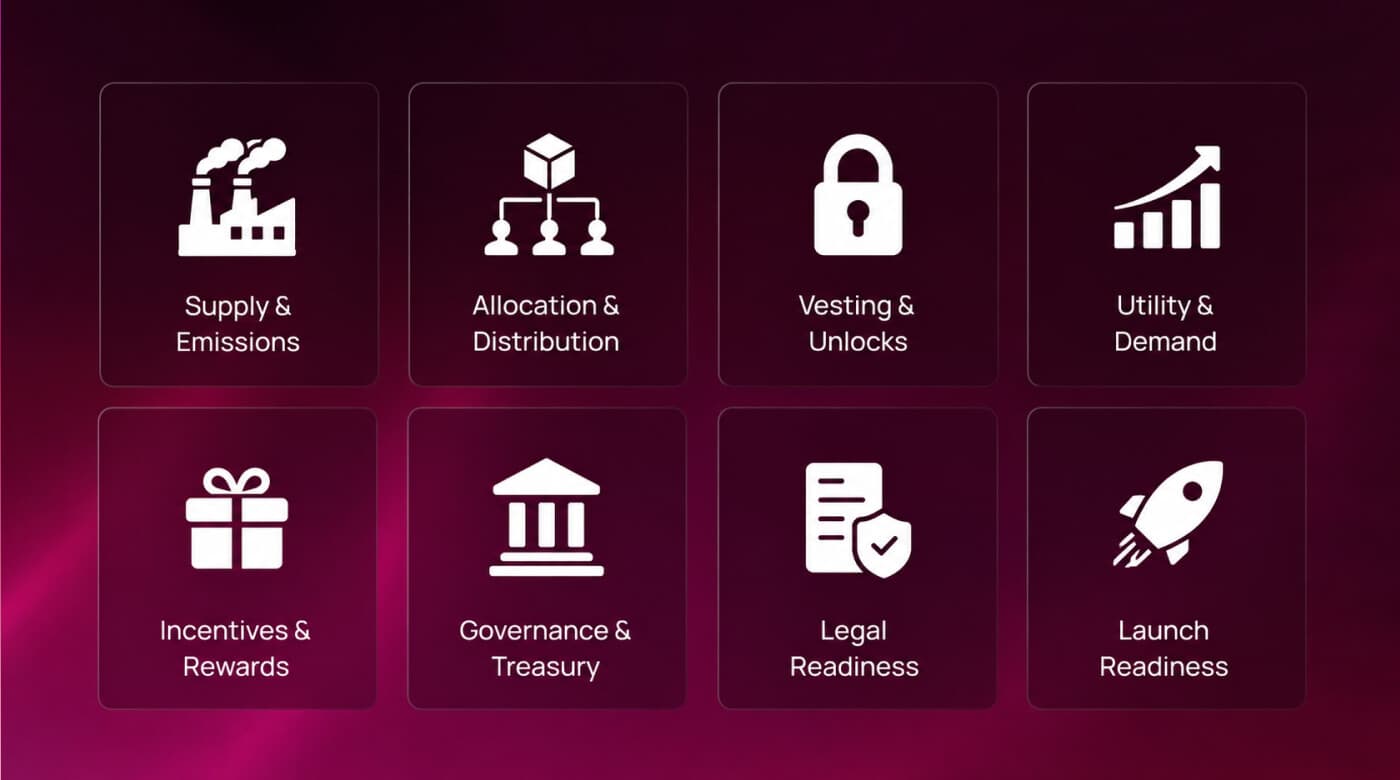
- A comprehensive tokenomics audit checklist helps verify that every major component of a token economy has been considered before launch or redesign.
- Projects that systematically evaluate every aspect of their tokenomics are better positioned to identify weaknesses early on and build a more resilient long-term economic model.
- Strong tokenomics depends on balancing supply, distribution, utility, incentives, governance, treasury management, legal readiness, and market preparation – not optimizing any one area in isolation.
- The best time to review a token economy is before a TGE, fundraising, or a major token redesign, before a lot of the effects are set in stone.
- A tokenomics checklist is no substitute for the detailed modeling, stress-testing, and analysis done during an audit, which is far more extensive.
FAQ
How long is a tokenomics checklist?
There is no fixed length. A comprehensive tokenomics checklist should cover every major part of a token economy, including supply, distribution, vesting, utility, incentives, governance, legal considerations, and launch readiness. The complexity depends on the project’s design.
Can I evaluate my own tokenomics using a checklist?
Yes. It is a useful way to identify obvious gaps and verify that each part of the token economy has been considered. However, it cannot replace detailed economic modeling, stress testing, or a professional tokenomics audit.
What’s the difference between a tokenomics audit checklist and a tokenomics audit?
A checklist helps projects review key design elements, while a full-blown audit involves an actual independent analysis of how those elements interact. Audits model different market scenarios, stress-test the token economy, and provide recommendations along with their priority level.
When should I complete a tokenomics checklist?
The most important times to get one done are before a TGE, raising capital, and when you’re about to make major changes to an existing token model. Once major turning points like these are crossed, there are numerous effects that cannot be undone.
Does completing a tokenomics audit checklist guarantee project success?
No. A checklist helps reduce the risk of overlooking important aspects of a token economy, but it cannot guarantee adoption, token price performance, or long-term success. The true utility of a project, the market conditions, and how well the plan is executed under consultation will be huge factors as well.
About 8Blocks
8Blocks is a token economy design firm working with Web3-native teams and Web2 businesses entering Web3. Since 2017, the company has designed tokenized economic systems where the token functions as part of the business model rather than a standalone asset. 8Blocks delivers tokenomics design, strategic consulting, tokenomics audits, and launch strategy, connecting business modeling, token mechanics, and investor materials into one coherent model.
Disclaimer
This content is provided for informational and educational purposes only. It does not constitute investment, financial, legal, or tax advice, and is not a recommendation to buy, sell, or hold any token or digital asset. Token design does not guarantee any financial return, token price performance, or regulatory outcome. Crypto assets carry a high risk of loss. The legal classification of a token depends on its specific structure and the applicable jurisdiction. Readers should conduct independent research and consult qualified legal and financial advisors.

What Is a Tokenomics Audit and Why It's So Essential
A tokenomics audit is essential to give token projects a chance to succeed. This covers interaction between core project components and stakeholders. Such audits provide useful recommendations, scoring, and reports that help rectify vulnerabilities and seize opportunities.

The 5 Most Common Tokenomics Mistakes and How to Avoid Them
Most tokenomics mistakes happen before launch, while the team still has time to fix them. The problem is rarely one wrong formula. It’s the lack of a system: the token should be part of the business model, not a separate asset attached to the product at the last minute.

6 Common Loose Ends That Come Back to Haunt Crypto Projects
Launching crypto tokens takes an awful lot of dedication and enthusiasm. However, it is the dullest, most obvious oversights that so often end up as their downfall. Learn about accounting for budget, timeline, audience, tokenomics, unit economics, and funding sources.